
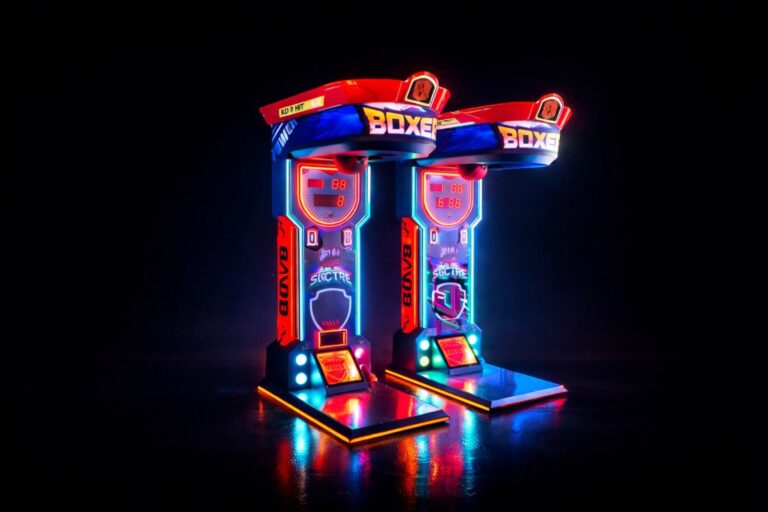
You may have seen many situations like this: sometimes a smaller person scores higher, while someone who looks much stronger gets only an average score.
Naturally, this raises a question:
Are punching machines accurate?
In many people’s understanding, a stronger person should have greater absolute strength, and a punching machine should display a higher score accordingly. If it doesn’t, the machine must be inaccurate — right?
Is that assumption correct?
This article is your definitive guide to answering that question.
What Punching Machines Really Measure — Force, Speed, and Acceleration
To determine whether punching machines are accurate, we first need to understand what they actually measure.
Many people believe punching machines measure “strength.”
But from a physics perspective, force is not an isolated number — it is closely related to changes in velocity.
Most punching machines do not directly measure the “absolute force” of your punch. Instead, they typically measure:
The change in velocity at the moment of impact
The acceleration generated by the strike
The vibration intensity after the target is hit
In simple terms, machines detect sudden impact changes, not sustained pressure.
This is the core issue:
If you slowly push with great force, your score may not be high.
But if you deliver a fast, sharp, concentrated burst of power, the machine is more likely to give you a higher score.
So rhythm and explosive timing matter more than raw strength alone.
Inside the “Black Box”: How Different Machines Work
Not all punching machines are built the same. Their internal structures vary.
1) Swing-Arm Mechanism (Common in Arcade Models)
These machines calculate scores based on how far an internal arm swings after being struck.
The greater the swing amplitude, the higher the score.
However, the swing depends not only on force, but also on:
Impact angle
Strike location
Speed at the moment of contact
If your angle is off, even a powerful punch may result in an average score.
2) Air Cushion or Pressure Sensor Systems
These machines measure impact intensity through internal pressure changes.
Compared to swing-arm models, they are somewhat closer to measuring real impact force, but they are still influenced by:
Whether you hit the center
Whether sliding contact occurs
Whether the force is concentrated in a single instant
If your force is spread out over a longer duration, the machine may fail to detect a strong peak value.
Key Similarities
Although measurement methods differ, most machines share common traits:
They emphasize instantaneous impact peaks
They are highly sensitive to angle and speed
They are not equivalent to professional force-measuring equipment
The Truth Behind High Scores — Technique Beats Brute Strength
As discussed earlier, punching machines prioritize peak impact within the shortest time frame rather than sustained force output.
This means:
Whoever can release the highest speed in the shortest time is more likely to score higher.
That’s the real reason technique often beats raw power.
Breaking Down the Key Technical Factors
1) The Kinetic Chain — Power Starts from the Ground
High scores don’t come from the arm alone. They come from full-body coordination.
An effective punch usually follows this sequence:
Feet generate force
The body rotates
The shoulder drives forward
The arm accelerates last
If you punch using only your arm, power dissipates.
If your whole body participates, the speed at the end of the fist increases significantly.
And punching machines are far more sensitive to terminal speed than to how many muscles you used.
2) Precision Matters — Don’t Just Hit Anywhere
For most machines, the optimal striking point is slightly below the center of the target.
If you hit the edge:
Force disperses
Impact direction shifts
The recorded peak value decreases
Even a very strong punch can score poorly if the angle is wrong.
3) Timing and Rebound — The Hidden Scoring Detail
Some swing-arm machines create a rebound effect after impact.
If your timing is correct and your punch delivers a concentrated burst rather than a pushing motion, the machine is more likely to record the highest peak value.
The key is not “more force,” but “more concentration.”
That’s why technically skilled players often achieve consistently high scores.
How Equipment and Calibration Affect Accuracy
Many people assume punching machines are standardized devices. In reality, they are not.
No Unified Standard
Arcade punching machines do not follow a universal calibration system like laboratory equipment.
Even the same model in different locations can produce noticeably different scores due to:
Adjustable difficulty settings
Different sensitivity configurations
Aging internal springs or air systems
Wear and tear affecting readings
This means:
Scoring 900 in Mall A does not guarantee you’ll score 900 in Mall B.
The “Gray Area” of Calibration
Some operators adjust sensitivity to:
Increase challenge
Control prize costs
Encourage repeat attempts
This is not necessarily cheating — it’s part of entertainment operation strategy.
But scientifically speaking, it further proves that:
Punching machines function more as entertainment scoring systems than precise force-measuring instruments.
So… Are Punching Machines Accurate?
It depends on how you define “accurate.”
If you treat the machine as:
A relative comparison tool on the same device
A test of explosive timing
An entertainment challenge
Then yes — it is functionally valid.
But if you treat it as:
A precise absolute force measurement instrument
A scientific training evaluation tool
Then no — it does not qualify.
The key is proper positioning.
Punching machines don’t measure “how strong you are.”
They measure whether you can release force explosively in a single instant.
Professional Alternatives for Measuring True Force
Equipment used in professional training differs significantly from arcade machines.
Examples include:
Professional impact testing systems
Electronic boxing training pads
Laboratory-grade force measurement platforms
These devices can measure:
Peak impact
Duration
Force curve variations
They focus on complete data sets rather than a single entertainment score.
In contrast, arcade machines simply provide one gamified number.

FAQ
Are punching machines accurate?
Punching machines are accurate within their intended purpose, but they do not measure absolute strength. Most arcade machines measure peak impact, acceleration, and vibration at the moment of contact rather than sustained force. They are reliable for comparing scores on the same machine, but they are not scientific strength-testing devices.
Are punching machines reliable?
Punching machines are generally reliable as entertainment scoring systems. However, they are not standardized or universally calibrated. Scores may vary between locations due to different sensitivity settings, wear and tear, or operator adjustments.
Are arcade punch machines accurate?
Arcade punch machines are designed for entertainment, not laboratory precision. They accurately detect sudden impact changes, but they do not measure true biomechanical punching force in a scientific way.
What do punching machines measure?
Most punching machines measure:
Speed at impact
Acceleration
Vibration intensity
Swing amplitude (in mechanical models)
They focus on explosive impact rather than continuous force application.
Are punching machines calibrated differently?
Yes. Arcade punching machines do not follow a universal calibration standard. Operators can adjust sensitivity, and internal components may change over time. This is why scores can vary between machines, even if they are the same model.
Is there a trick to punching machines?
There is no “secret trick,” but technique matters significantly. Delivering a fast, explosive, well-angled punch to the optimal strike zone produces higher peak impact readings than simply pushing hard.
Where to hit the punching machine?
For most arcade machines, the optimal strike point is slightly below the center of the target. Hitting the edge or off-angle disperses force and lowers the recorded peak value.
Conclusion — How to View and Use Punching Machines Wisely
Let’s summarize the core points:
Punching machines prioritize speed and instantaneous impact
Technique often matters more than brute strength
There is no universal standard across machines
Scores do not represent absolute strength
The correct approach is:
Treat them as entertainment challenges, not authoritative certifications of physical ability.
If you want scientifically accurate strength testing, use professional equipment.
Once you understand this, you won’t be misled by the numbers. Instead, you’ll start asking a better question:
How can you deliver each punch more efficiently and explosively?




 English
  Español
  العربية
  Français