OHS vs FPU vs Battery: How Bumper Cars Work
Commercial bumper cars typically use three power systems:
-
OHS (Overhead System) – A classic ceiling-and-floor power grid for permanent indoor installations. Offers continuous power, consistent performance, and high throughput.
-
FPU (Floor Pick-Up) – Conductive floor strips deliver power without ceiling nets. Ideal for clean interior design and mid-to-large venues.
-
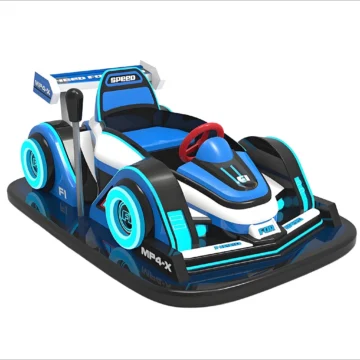
Battery-Powered – Onboard lithium packs enable flexible layouts, pop-up events, and multi-use venues. Requires charging rotation and battery management.
Which to choose?
-
Choose OHS if you run a high-capacity, permanent indoor park aiming for maximum uptime.
-
Choose FPU if you want a modern look and easier building integration without overhead nets.
-
Choose Battery if you need mobility, quick deployment, or temporary/seasonal operations.
Safety & Compliance
Safety is engineered into every component:
-
Structural & Speed Control – Reinforced chassis, padded bumpers, and controller-level speed limits tailored for kids, adults, or mixed groups.
-
Operator Systems – E-stop switches, remote disable, pre-ride checklist, and one-way traffic layout guidelines.
-
Rider Restraints – Seat belts, anti-slip seating, and protected steering columns.
-
Materials & EMC – Flame-retardant body panels, low-smoke cabling, shielded electronics, compliant with common EMC directives.
-
Documentation – Risk assessments, daily inspection checklist, staff training SOP, and incident report templates.
Buying Guide: Pick the Right Setup
Match your venue goals with the correct configuration:
-
Throughput Target – If you need >350 riders/hour, prefer OHS or FPU with quick dispatch and short cycle times.
-
Venue Type – Shopping malls and event halls often pick Battery for flexible footprints; large indoor parks prefer OHS/FPU.
-
Audience Mix – For family attractions, 2-seater models with adjustable speed profiles maximize inclusivity.
-
Maintenance Capacity – If your team is small, consider Battery with quick-swap packs and remote diagnostics.
-
Budget & ROI – Combine car count, ride cycle length, and ticket price to estimate payback. Our ROI worksheet and case studies can help you plan.
Floorplan & Venue Planning
Design for safety, flow, and capacity:
-
Track Layout – Oval or kidney shapes reduce head-on contact risk and improve circulation.
-
Barrier System – Soft railings + corner cushions; allocate a maintenance bay and a clear operator line of sight.
-
Signage & Wayfinding – Pre-ride rules, height/weight guidance, queue markers, and one-way arrows.
-
Electrical & Charging – For OHS/FPU, plan dedicated power feeds and isolation; for Battery, set up a ventilated charging corner with fire-safe storage.
-
Accessibility – Wider gates, step-assist for kids, and space for attendants to assist riders.
Operations: Run a Smooth, Safe Ride
-
Cycle Design – 60–120 second ride windows + 30–45 second loading keep queues moving.
-
Staffing – One operator + one gate attendant per 8–12 cars is a common baseline; scale up on peak days.
-
Daily Checks – Tire pressure/rollers, belt latches, lights, horn, and E-stop tests before opening.
-
Battery Routines – Rotate packs by state-of-charge; avoid deep discharge to extend life.
-
Guest Experience – Clear rules, upbeat music, synchronized light shows, and themed announcements raise satisfaction and repeat rides.
Pricing, Lead Time & Warranty
-
What affects price – Power system (OHS/FPU/Battery), body material, seat count, lighting package, theming, and quantity.
-
Typical timeline – Sample confirmation → production → QA → shipping/installation support.
-
Warranty & Parts – Standard limited warranty with spare parts kit; remote diagnostics and training available.
-
Total Cost of Ownership – Energy use, consumables (tires/rollers), battery lifecycle (for Battery), preventive maintenance.
FAQs
Q1: Are bumper cars suitable for outdoor use?
Yes—choose weather-resistant materials, sealed electronics, and a covered control station. Battery models are most common outdoors.
Q2: How fast do they go?
Most venues limit top speed for safety; controllers can set separate profiles for kids, adults, or mixed sessions.
Q3: What height/weight limits apply?
Follow manufacturer guidance and local regulations. We provide printable signage with clear rider requirements.
Q4: How many cars fit my space?
Rule of thumb: start at 6–8 cars for ~80–120 m² and scale up. Smooth traffic flow is more important than pure density.
Q5: What’s the maintenance workload?
Daily checks are quick; schedule weekly and monthly inspections. We supply checklists, spare kits, and remote support.
Q6: OHS vs FPU vs Battery—how do I decide?
Pick based on permanence, aesthetics, electrical infrastructure, and operations. Our team can model throughput and ROI for each option.


 English
  Español
 العربية
 Français