
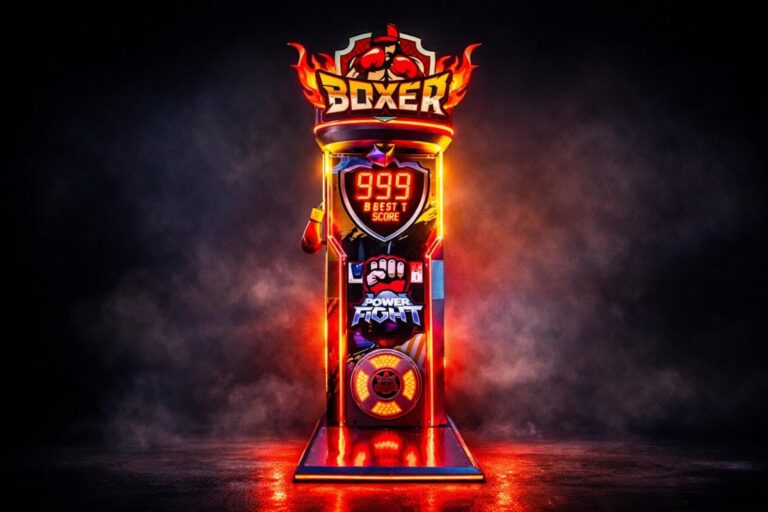
Have you ever seen someone hit 999 on a boxing arcade machine? Do you know what a 999 score actually means—and how people manage to reach it? As an experienced boxing arcade machine manufacturer with deep research into these machines, I’ll use this article to help you fully understand what’s behind that number.
The Secret to Reaching 999: A Full Breakdown of How Boxing Machines Work
Many people think the score on a boxing machine is simply “how much power you have.” But the reality is closer to this: the machine is looking at how violent the impact is and how fast the change happens, then converting that into a score that’s easy to understand.
1) What does a boxing machine actually “measure”?
Most boxing machines / punch strength testers use internal sensors to capture what happens at the instant of impact. The common approaches usually fall into two types:
Measuring the change in impact: For example, after the bag/striking head (often mounted on a hinge) is hit, it accelerates quickly and then hits a stopper/limit point. The machine estimates how “strong” the hit was by measuring changes in acceleration or speed.
Measuring force change at contact: The striking pad may use components that sense force/pressure changes, converting the impact into an electrical signal and then into a value/score.
So the “score” on the screen is usually not a strict physical unit. It’s typically an algorithm-generated performance score (and different brands/models can use different algorithms).
2) Why is “speed” often more important than you think?
With the same punch, a hit that’s fast, crisp, and concentrated often scores higher. The reason is straightforward:
Many machines capture the peak change—how “sudden” the impact is. The bigger the acceleration change, the higher the score tends to look.
In the simplest terms: power isn’t only about “trying harder,” it’s also about acceleration. You can think of it like:
F = m × a (the faster you accelerate something, the larger a becomes, and the impact looks more explosive)
That’s why some people don’t look the strongest, yet still score very high—because their power delivery is faster and more focused.
Quick reminder: don’t obsess over whether the machine is “accurate.” A boxing machine is more of an entertainment + comparison tool. On the same machine, using the same technique and the same contact point repeatedly, the score becomes meaningful as a reference.
3) Why is the maximum score so often 999?
You’ll notice many boxing machines cap the top score at 999. That’s usually not because human strength “tops out” there, but because:
The display and rules feel more intuitive: a three-digit max score looks like “you hit the ceiling / broke the record.”
The machine needs a cap: to prevent overflow, avoid extreme impacts pushing values too high, and make a “max score” rare and challenging.
In other words: 999 is a level cap, not a real-world limit of punching power. Even if a professional athlete hits the machine, many models will still only display 999.
Peak Power: Legendary 999 Moments and High-Score Records
As explained above, the scoring logic isn’t mainly about “how big your muscles are,” but about speed, how concentrated the contact is, and how smoothly power transfers. That’s why both professional athletes and ordinary players can reach 999.
1) Professionals hitting 999: what they have in common
Professional athletes who hit 999 usually show very similar traits:
Short path, clean motion: the punch doesn’t loop or drag.
Clear whole-body drive: not just swinging the arm—power flows from foot → waist/hips → shoulder.
Consistent contact point: they hit the same “sweet spot,” without drifting.
Crisp contact: the impact feels “sharp,” and they retract quickly afterward.
So 999 is often like a “clear screen” sign: when movement quality, speed, and contact point all land perfectly—plus the machine’s cap—you get the maxed-out display.
2) Ordinary players can score high too—why?
High scores aren’t limited to professionals. The reason is simple: many machines reward movement quality more than pure “brute strength.” Three common patterns:
Faster often scores better: with the same movement, more speed makes the score jump.
More accurate looks better: tighter contact makes the number more stable and easier to push higher.
Smoother wastes less effort: clean transfer from foot to fist can look “not that hard,” yet produce a higher score.
This explains a common experience: sometimes you don’t feel like you used your maximum strength, yet the score is higher—because that punch was faster, more concentrated, and cleaner.
Also remember: scores are not always comparable across different machines. Brand, model, sensitivity, installation tightness, and machine age can all affect the display. The more reliable approach is to track improvement on the same machine—the gap between “occasional high scores” and “consistent high scores” is huge.
Beyond Talent: The Scientific Process and Step-by-Step Training to Hit 999
A 999 score is usually the result of correct mechanics + enough speed + accurate contact. You don’t need to become a bodybuilding champion. Instead, you need to learn how to send power from your feet to your fist like a whip—that fast, crisp feeling is what most often produces high scores.
Below is a trainable process. Follow it and you can noticeably raise your score ceiling.
1) Technique breakdown: one punch, five trainable checkpoints
Treat the boxing machine like a test. You don’t need “more effort,” you need to be smoother, faster, and more concentrated. A common power sequence is:
push off the ground → rotate the hips → upper body follows → arm whips out → tighten instantly at contact
A. Stance and ground drive: stabilize first, then strike
Don’t stand too narrow: keep your base stable; don’t let your center drift.
Before punching, “wind up lightly”: drive from the rear foot (or power foot) and let the body start rotating.
Think of it as borrowing the ground’s “rebound” and sending it upward.
Common mistake: swinging the arm first while the feet do nothing. It looks forceful, but the score often stays low.
B. Rotation: the core of high scores isn’t the hand—it’s the hips
Many high-score punches look like the whole body delivers the hit, not the hand “tapping” the target.
Imagine your hips as a door hinge: rotate the hips first, then the shoulder, and the fist comes last.
If you do this well, you’ll clearly feel the punch becomes smoother—and speed comes much easier.
C. Breathing timing: a short exhale makes the hit more “crisp”
Don’t hold your breath, and don’t exhale slowly like a sigh. A better approach is a short “ha!” at the instant of contact. Many training explanations emphasize that a short, sharp exhale helps you stay relaxed while making the contact moment cleaner.
D. The “whip” effect: relax first, then tighten—only for an instant
To chase high scores, the key is often not staying tense the whole time, but:
Stay relaxed on the way out so the fist can snap forward;
Tighten only at the moment of contact, then retract immediately.
This “snap out + instant tighten” concept is repeatedly mentioned in training for a fast, crisp punch.
E. Sweet-spot targeting: the more concentrated the contact, the better the score
Boxing machines strongly reward a consistent impact point. With the same punch, if you hit off-center or scatter the contact, the score drops noticeably.
The goal isn’t “hit with huge force,” but “hit very precisely.”
Keep the wrist straight—don’t bend it.
If you hit a hard striking surface with bare knuckles (not recommended), it’s safer to use a more stable contact surface and protect your hand. Some discussions mention that the first two knuckles feel steadier, but what matters most is wrist alignment and clean contact.
2) A trainable “999 rhythm”: follow this punch tempo
Treat this like a cue and practice until it becomes automatic:
stabilize → push off → rotate hips → shoulder follows → whip the arm out → instant tighten + short exhale at contact → retract immediately
This rhythm solves three things at once: speed, focus, and consistency.
3) Helpful training: simple gym drills that work
If you want your scores to rise more consistently, besides doing the motion correctly, your body needs to produce fast power more easily. These drills are commonly used to build rotational explosiveness and speed-strength:
Rotational medicine ball throws / wall slams (most recommended): the movement resembles transferring power from foot → hips → hand.
Fast push-ups / clap push-ups (only if appropriate): trains arm explosiveness and full-body coordination. (Don’t chase reps—chase fast, stable form.)
Core rotation drills (band twists, anti-rotation work): the goal is to rotate fast without losing structure.
Speed-strength training can improve punching speed and power performance, so “training faster” is often more useful than “training harder.”
4) Reminder: don’t turn score-chasing into injury
Keep the wrist straight—avoid bending on impact.
Don’t punch with shrugged shoulders; the more you shrug, the slower you get.
Warm up (shoulder, elbow, wrist + hips) before chasing high scores.
If the machine is very hard, wear gloves or protection—don’t do “bone-on-hard-surface” challenges.

What Your Score Means: A Practical Score Range Guide
First, an important fact: boxing machine scores are not internationally standardized. Different brands, models, and even how tightly the machine is installed (or how worn it is) can change the displayed score.
So these ranges are best used to answer two questions:
“On this machine, what level am I?”
“If I want a higher score, what should I change?”
Think of the number as a performance score that combines punch speed, contact concentration, and how smoothly power transfers, then turns it into a single value.
Beginner (100–300): you have strength, but your power is “scattered”
What it looks like:
You can move the bag, but the score is unstable. Sometimes it feels like you hit hard, yet the number stays low.
Most common causes:
Unstable stance; no drive from the feet
Only arm-swinging; the body doesn’t follow
Inconsistent contact point; you hit off-center
Fastest improvements (two are enough):
Stabilize first: set your stance before punching
Be accurate: aim for the same spot each time (don’t chase a huge swing)
Hobbyist (300–600): your form is improving, but not “fast and crisp” yet
What it looks like:
You start to feel smoother power delivery. Scores are more stable, and you occasionally surprise yourself.
Most common causes:
The body follows, but rotation is weak
Staying tense the whole time, so speed won’t rise
Contact isn’t clean; after impact you “stick” on the pad
Fastest improvements:
Train the snap: relax on the way out, tighten only at contact, retract immediately
Train rotation: drive the hips and shoulder like wringing a towel—don’t just swing the arm
Skilled (600–850): you already understand “punching with the body”
What it looks like:
Your movement looks lighter, but your scores are higher. Power feels like the whole body delivers it.
Most common situation:
You can generate speed using foot + hip drive
Plateaus usually come from contact point, punch rhythm, and final concentration at impact
Fastest improvements:
Make the contact point automatic: hit the same sweet spot every time
Fix the rhythm: stabilize → push off → rotate hips → punch → instant tighten → retract (the more stable, the easier to break records)
Elite (850–998): what you’re missing isn’t strength—it’s details
What it looks like:
You’re already among the strong hitters. Moving higher is less about big changes and more about small refinements.
Common reasons:
Many machines are extremely sensitive to the peak moment: a 10–30 score gap can be just slightly more accuracy, speed, or cleanliness
Sometimes you don’t feel like you hit harder, yet the score is higher—because it was smoother and more focused
Fastest improvements (three-sprint set):
More relaxed: tighter = slower
More focused: same spot, same angle
More decisive: retract right after impact—don’t “push into” the pad
Legend (999): you reached the machine’s cap
What it looks like:
Congratulations—this usually means you triggered the machine’s maximum display. It’s not that you can only reach 999; it’s that the machine only shows up to 999.
So:
999 is not the world’s punching power limit; it’s the top score cap on many machines.
Think of it as a “clear screen” moment: technique, speed, and accuracy aligned perfectly in that punch.
FAQ
1) “Why am I strong, but my score isn’t high?”
Because boxing machines often reward not “how big you are,” but how fast, accurate, and concentrated your punch is.
Most common reasons:
Only swinging the arm: the body (feet, hips, shoulders) isn’t involved
Staying tense the whole time: tighter = slower; speed drops
Inconsistent contact point: even a small miss can drop the score a lot
Self-check: use roughly the same effort and punch five times in a row. If the scores swing wildly, you’re likely stuck on consistent contact + smooth mechanics.
2) “Can scores from different brands be compared directly?”
Not completely.
Different machines may use different sensors, algorithms, sensitivity settings, and maintenance conditions.
More reliable comparison:
Same machine: compare your personal best, your average, and your consistency
Same brand + same model: you can reference it loosely, but still consider age and installation tightness
In short: treat it as a same-machine performance score, not a universal strength unit.
3) “Which punch scores higher—straight punch or hook?”
On most machines, the easiest way to score high consistently is a motion with a short path, a straight line, and easy control of the contact point (many people use a straight-punch style).
Why:
Straighter path = easier to hit the sweet spot
Shorter motion = easier to create a sharp peak
With good hip rotation, scores become more stable
But ultimately, choose the motion you can deliver most accurately, fastest, and most consistently.
4) “Where should I hit—center or edge?”
In most cases: the more concentrated the hit, the better.
Think in terms of a sweet-spot zone: same point, same angle, same rhythm.
A practical tip:
Do 3–5 medium-effort hits to find the feel
Once you find the contact point that gives the highest score, then start pushing for max
5) Is 900 a good score on a punching machine?
Yes—900+ is usually a very strong score. On many machines, it suggests your punch is fast, crisp, and hitting the sweet spot consistently, not just “muscle power.”
6) What is the highest score on a boxing machine?
On many models, the highest displayed score is 999. But 999 is typically a score cap (a built-in limit)—not a real-world “maximum human punching power.”
7) How to get a higher score on a punching machine?
Start with the fastest, highest-impact changes:
Hit the same contact point every time (sweet spot)
Use hip rotation (whole body, not just the arm)
Create a snap: relaxed on the way out, instant tighten at contact, quick retraction
Add simple training like rotational medicine-ball throws to build fast power
8) What do the numbers on a punching machine mean?
They’re usually an algorithm-generated performance score, not a strict physical unit. The machine converts sensor signals from the impact into a number that often reflects how sudden and concentrated the hit is.
9) What is the punching machine score based on?
Typically, it’s based on sensor readings that capture the impact event—often emphasizing the peak change (how “sudden” the hit is). That’s why a faster, cleaner punch can score higher than a slower “push.”
10) Do punching machines measure speed or power?
Most machines don’t measure “power” the way a lab instrument does. In practice, the score is heavily influenced by how fast the impact spike happens (speed/acceleration effect) and how concentrated the contact is.
11) Can you compare punching machine scores between machines?
Not reliably. The best comparison is you vs. you on the same machine. Cross-machine comparisons can be misleading because scoring systems and sensitivity differ.




 English
  Español
  العربية
  Français