

La plupart des gens s'approchent d'un machine à frapper d'arcade L'idée est simple : frapper aussi fort que possible et voir la résistance de l'adversaire. Mais le score affiché à l'écran ne reflète pas votre force maximale.“
Le fonctionnement d'une machine de boxe d'arcade est en réalité bien plus intelligent et subtil qu'on ne le croit. Elle ne se contente pas de mesurer la force physique ; bien souvent, elle s'intéresse davantage à la vitesse d'impact.
Dans ce guide, nous allons examiner l'intérieur de la coque extérieure rigide de la machine, explorer sa structure mécanique et son “ cerveau ” interne, et découvrir le véritable secret qui se cache derrière ces scores impressionnants de “ 999 ”.
Pourquoi la vitesse prime sur la force : la physique derrière les scores élevés des machines de boxe
Entrez dans une salle d'arcade, et vous assisterez souvent à une scène classique : un homme grand et musclé rassemble toutes ses forces et se jette sur la cible de frappe comme un bulldozer, mais le score final est étonnamment bas. Puis, un joueur plus mince à côté de lui assène un coup de poing rapide et précis, la cible se redresse avec un claquement sec, et la machine affiche soudain un score proche du maximum.
Cela ne signifie pas que la machine est défectueuse. Cela signifie qu'elle comprend la physique mieux que la plupart des joueurs.
Cessez de mal comprendre Newton : le véritable secret derrière F = ma
Pour comprendre le fonctionnement d'une machine à poinçonner d'arcade, il faut se pencher sur la deuxième loi de Newton, une formule que beaucoup ont apprise à l'école :
F = ma
Dans cette formule, F signifie force, m signifie masse et a signifie accélération.
Beaucoup pensent que si leur poing est assez lourd ou leur bras assez fort, la force exercée sera forcément importante. Mais ils oublient souvent un point essentiel : la masse de la cible à frapper dans la machine est fixe.
Puisque le poids de la cible reste constant, l'accélération devient le facteur déterminant. Autrement dit, plus votre coup accélère la cible au moment de l'impact, plus la machine enregistre la force du coup. Le système de notation cherche souvent à capter ce bref instant explosif.
Une comparaison simple : est-ce que vous poussez une voiture ou est-ce que vous enfoncez un clou avec un marteau ?
Pour simplifier la compréhension, on peut diviser les coups de poing en deux actions physiques très différentes.
Pousser une voiture lente : force importante, faible vitesse
Lorsque vous essayez d'utiliser tout votre corps pour pousser la cible, votre poing reste en contact avec elle pendant un temps relativement long. C'est comme pousser une voiture en panne : vous pouvez déployer beaucoup d'efforts, mais la voiture n'avance que lentement. Pour le processeur de la machine, ce type de poussée prolongée ne produit pas d'impact significatif. L'accélération est insuffisante, et le score risque donc d'être inférieur aux attentes.
Frapper un clou avec un marteau : contact bref, grande vitesse
Un bon coup de poing s'apparente à frapper un clou avec un marteau. Le marteau lui-même n'est peut-être pas très lourd, mais lorsqu'il frappe rapidement, l'énergie est transférée en un temps très court. Ce transfert d'énergie bref et précis fait reculer la cible du coup de poing.
Les capteurs internes de la machine sont sensibles à ce type d'impact rapide. Plus le temps de contact est court et plus la cible se déplace rapidement, meilleure sera la précision de la détection de l'impact par la machine.

Comment les machines de boxe mesurent votre coup de poing : les capteurs à l’œuvre derrière le score
De l'extérieur, un machine à frapper d'arcade Cela peut paraître simple : une cible qui se balance, une armoire et un écran de score. Mais le score réel dépend de la façon dont la machine “ détecte ” le coup à l’intérieur de son système.
Lorsque votre poing frappe la cible, un traitement de données rapide s'effectue sous le boîtier. La machine ne devine pas. Elle peut afficher un score très précis grâce à son système de mesure interne.
Les systèmes de détection peuvent varier selon les fabricants et les modèles de machines. Pour mesurer la vitesse ou l'impact du poinçon, de nombreuses machines utilisent un ou plusieurs des mécanismes suivants.
Système 1 : Capteurs optiques — La porte de lumière
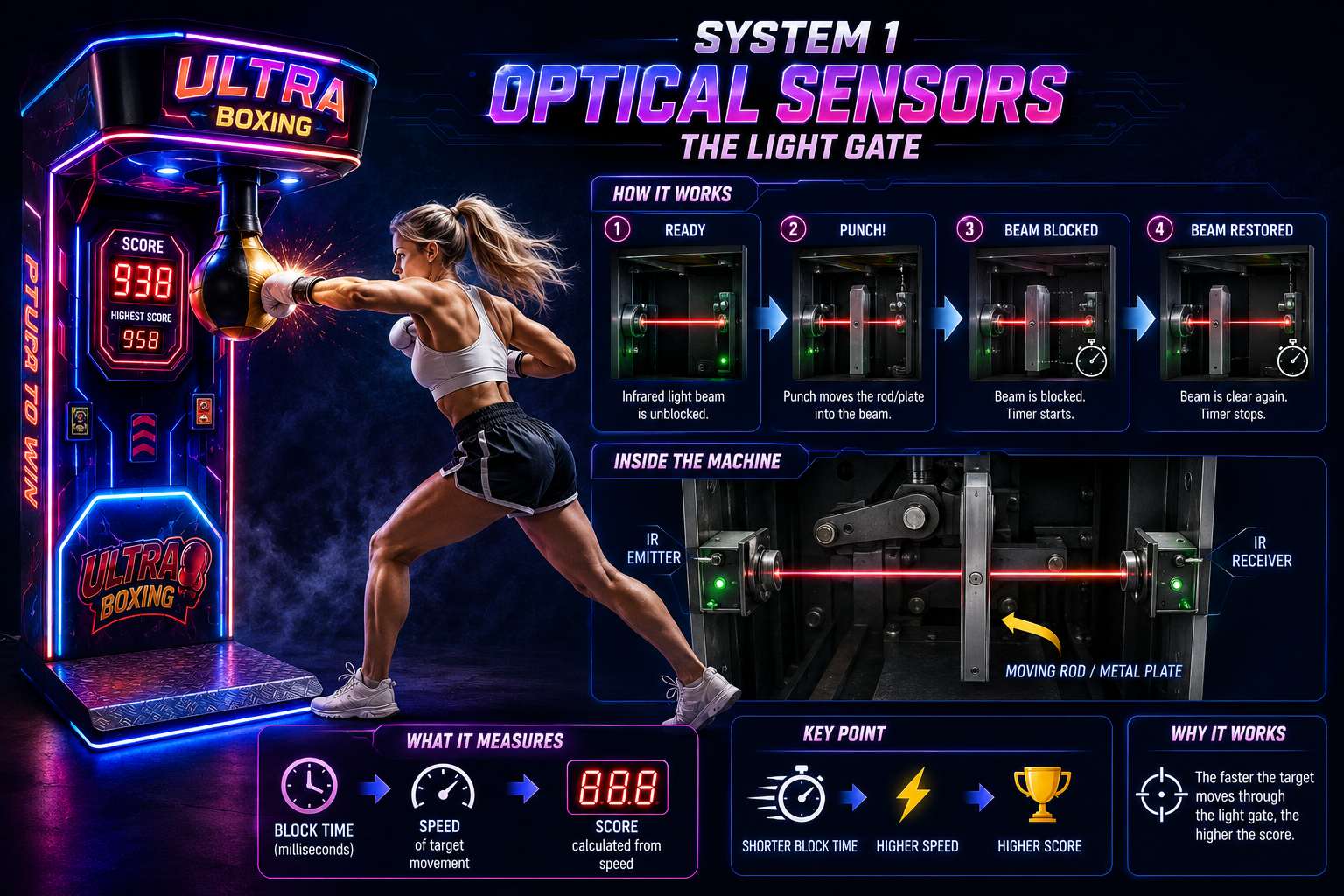
Les capteurs optiques sont couramment utilisés dans de nombreuses machines de jeux d'arcade modernes. L'idée peut paraître complexe, mais son principe de base est facile à comprendre.
Une barrière de lumière invisible
À l'intérieur de la machine, près du pivot ou de la zone de mouvement principale, se trouve un faisceau de lumière infrarouge invisible à l'œil nu.
Mesurer la durée pendant laquelle la lumière est bloquée
Lorsqu'on frappe la cible, la tige de liaison ou la plaque métallique se déplace avec elle et interrompt le faisceau lumineux. L'appareil mesure le temps écoulé entre l'interruption du faisceau et sa réapparition. Ce processus peut ne durer que quelques millisecondes.
Explication simple
Le chronomètre de la machine est très précis. Plus vous frappez vite, moins la pièce métallique met de temps à traverser le faisceau lumineux. En mesurant la durée d'occultation du faisceau, la machine estime la vitesse du mouvement de la cible et convertit ces données en un score.
Système 2 : Micro-interrupteurs et pièges à vitesse — Le déclencheur physique
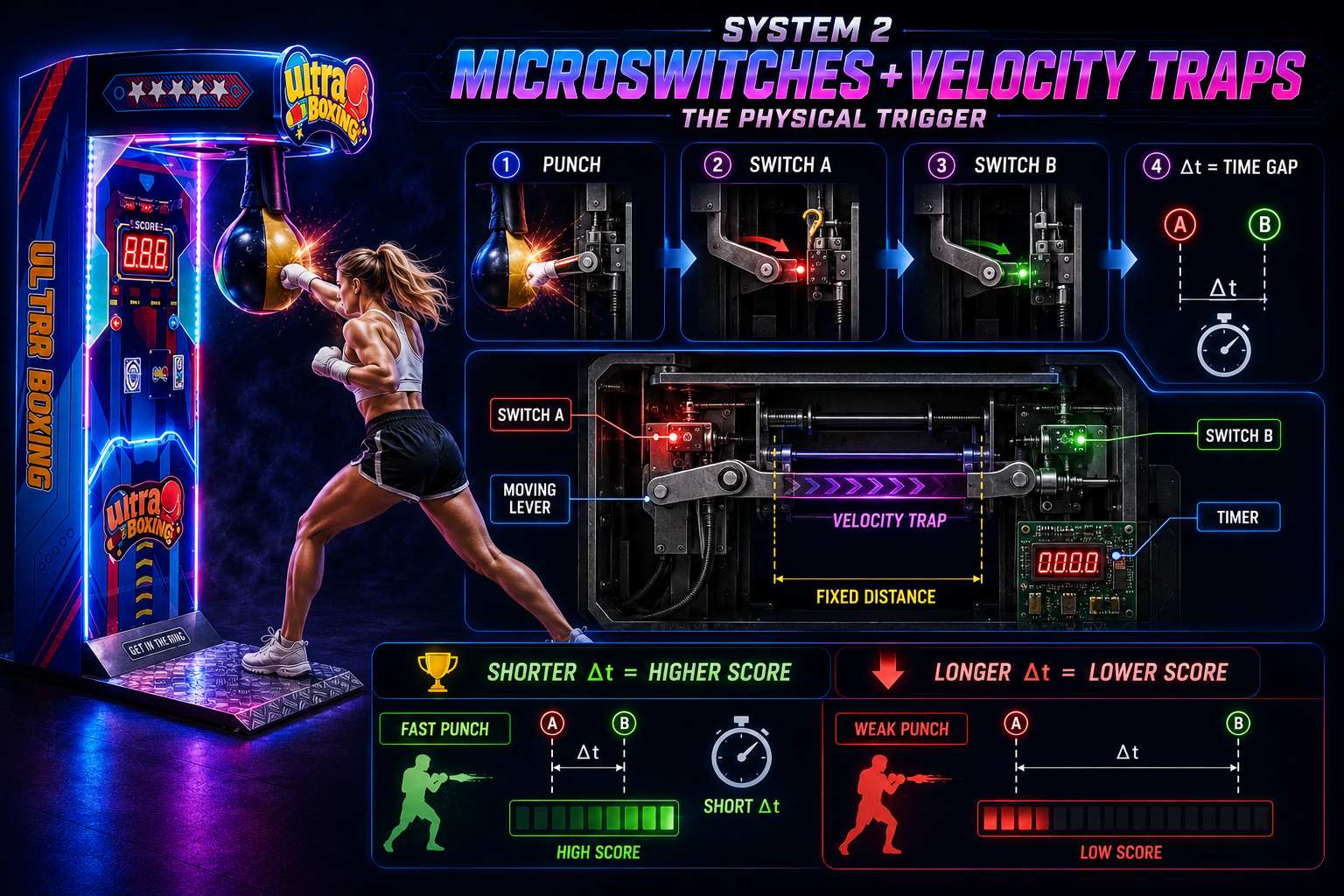
Certaines machines plus anciennes ou plus robustes utilisent une méthode plus mécanique : des micro-interrupteurs et des pièges à vitesse.
Conception de déclenchement en deux étapes
À l'intérieur de la machine, on peut trouver deux interrupteurs physiques sensibles, placés à une courte distance fixe l'un de l'autre. On peut les appeler interrupteur A et interrupteur B.
Un effet domino
Lorsque vous frappez la cible, le levier interne appuie d'abord sur l'interrupteur A. Ensuite, comme la cible continue de bouger en raison de son inertie, elle appuie sur l'interrupteur B.
Mesurer la différence de temps
La machine examine principalement une seule chose : le temps qui s’écoule entre le déclenchement de l’interrupteur A et celui de l’interrupteur B.
Si le coup est lent et faible, le délai entre les deux interrupteurs sera plus long. Si le coup est rapide et sec, les deux interrupteurs s'actionneront presque immédiatement l'un après l'autre. Plus l'intervalle de temps est court, plus le score a de chances d'être élevé.
Systèmes moins courants : potentiomètres et jauges de contrainte
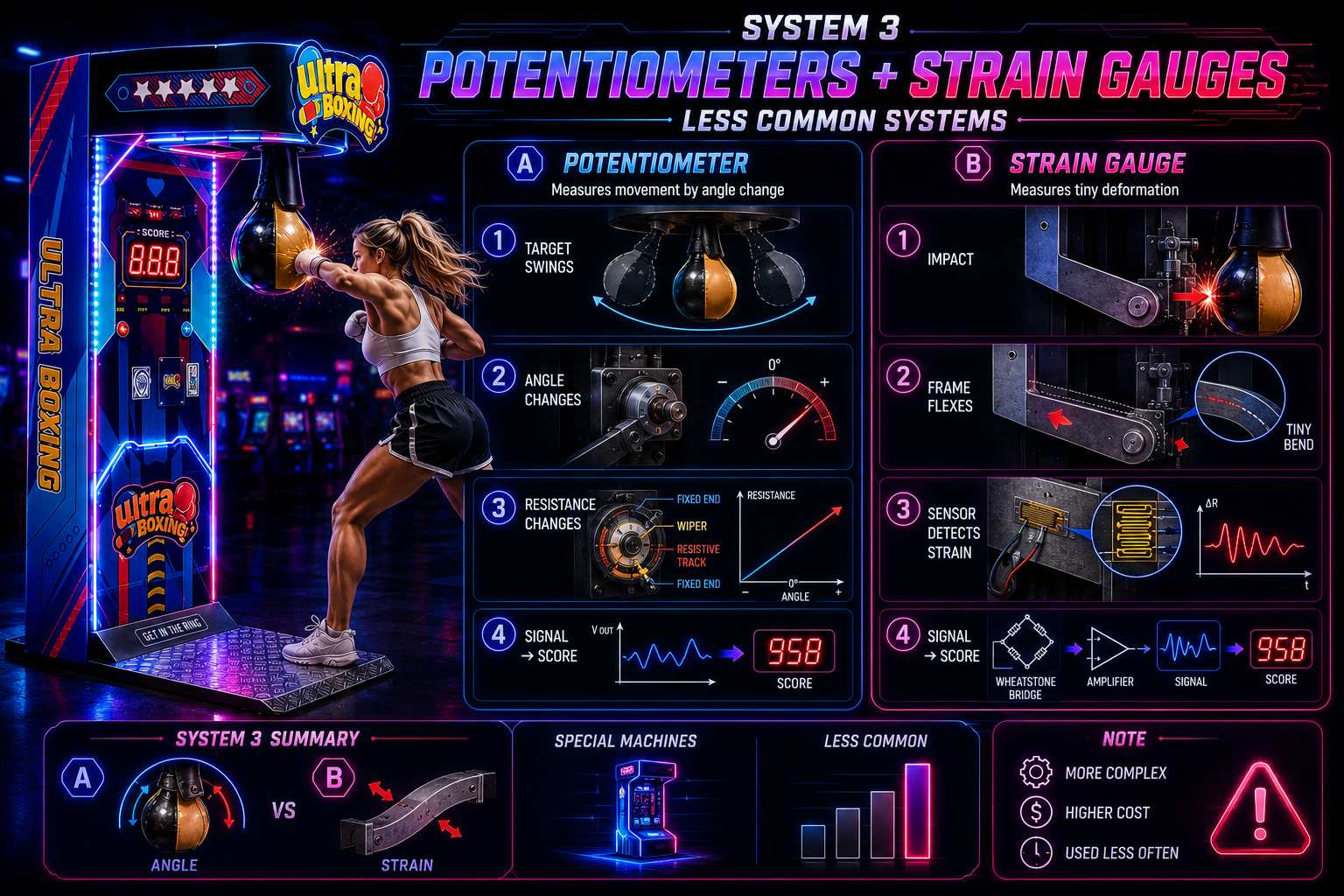
Outre les capteurs optiques et les micro-interrupteurs, certaines machines spéciales peuvent également utiliser d'autres méthodes.
Potentiomètres
Un potentiomètre est similaire au bouton de volume d'une radio. Il peut être installé près de la zone de pivot. Lorsque la cible se déplace, l'angle change, et la résistance électrique change également. La machine utilise cette variation pour estimer la force ou le mouvement de l'impact.
jauges de contrainte
Une jauge de contrainte est une petite bande sensible qui peut être fixée sur la zone cible ou sur une structure métallique. Lors d'un impact, le métal peut se déformer très légèrement. Cette déformation infime est presque imperceptible à l'œil nu, mais le capteur la détecte et l'utilise pour estimer l'impact.
Cependant, comme ces systèmes peuvent être plus coûteux ou plus faciles à endommager dans l'environnement parfois difficile des salles d'arcade, de nombreuses machines de frappe d'arcade classiques reposent encore principalement sur la vitesse, le timing et la détection des mouvements.
Outre les capteurs optiques et les micro-interrupteurs, certaines machines spéciales peuvent également utiliser d'autres méthodes.
Potentiomètres
Un potentiomètre est similaire au bouton de volume d'une radio. Il peut être installé près de la zone de pivot. Lorsque la cible se déplace, l'angle change, et la résistance électrique change également. La machine utilise cette variation pour estimer la force ou le mouvement de l'impact.
jauges de contrainte
Une jauge de contrainte est une petite bande sensible qui peut être fixée sur la zone cible ou sur une structure métallique. Lors d'un impact, le métal peut se déformer très légèrement. Cette déformation infime est presque imperceptible à l'œil nu, mais le capteur la détecte et l'utilise pour estimer l'impact.
Cependant, comme ces systèmes peuvent être plus coûteux ou plus faciles à endommager dans l'environnement parfois difficile des salles d'arcade, de nombreuses machines de frappe d'arcade classiques reposent encore principalement sur la vitesse, le timing et la détection des mouvements.
Une fois que la machine a capturé ces minuscules données temporelles, la question suivante est : comment transforme-t-elle ces données en un nombre intéressant tel que “ 888 ” ou “ 999 ” ?
Nous abordons maintenant la partie suivante : l’algorithme de notation qui se cache derrière l’écran.
L'algorithme de la boîte noire : pourquoi les scores des machines de boxe ne reflètent pas la réalité de la force réelle
Après avoir donné un coup de poing et vu l'écran s'arrêter sur “ 912 ”, vous pourriez penser que votre coup de poing a produit une force de “ 912 kilogrammes ”.
Mais ça ne marche pas vraiment comme ça.
Le chiffre affiché sur une borne d'arcade ne correspond généralement pas à une mesure scientifique de la force. En physique et en conception de jeux, il s'agit plutôt d'une unité arbitraire. Ce n'est pas votre force réelle en kilogrammes, en livres ou en newtons. Il s'agit en fait d'un score calculé par la machine après réception des données de chronométrage ou des données des capteurs.
En termes simples, ce nombre est à la fois une mesure et une conception de jeu.
Une formule simplifiée derrière le score
Pour de nombreuses machines de boxe d'arcade basées sur la vitesse, la logique de score peut être simplifiée comme suit :
Score = (k / Δt) + C
Ne vous inquiétez pas si cela paraît compliqué. Nous pouvons vous l'expliquer en termes simples.
Δt : la différence de temps
Il s'agit du temps mesuré par le capteur, par exemple la durée d'occultation du faisceau lumineux ou le temps nécessaire à l'activation de deux interrupteurs. Comme cette valeur figure au dénominateur, un temps plus court permet d'obtenir un score bien plus élevé.
C : le score de base
De nombreuses machines ont un score de base prédéfini. Cela évite que le score final ne soit trop bas et rend le jeu plus divertissant. Même si un joueur ne fait qu'effleurer la cible, la machine peut tout de même attribuer un score de base.
k : le coefficient de difficulté
Il s'agit d'un des aspects les plus importants du système de notation. Il peut influencer la facilité ou la difficulté à obtenir un score élevé.
Le paramètre caché que beaucoup de joueurs ignorent : le réglage de la difficulté
Avez-vous déjà essayé deux machines à frapper similaires dans la même salle d'arcade et obtenu des scores très différents avec un coup de poing presque identique ?
Peut-être qu'une machine vous donnera un “ 950 ”, tandis qu'une autre ne vous donnera qu'un “ 610 ”.”
Cela ne signifie pas forcément que vos performances ont changé. Cela peut simplement signifier que les machines ont des niveaux de difficulté différents.
Le menu opérateur caché
De nombreuses bornes d'arcade à pièces possèdent des paramètres internes accessibles uniquement au propriétaire ou au technicien. Ces paramètres permettent à l'opérateur de régler la sensibilité du système de score ou la difficulté.
Un moyen de contrôler le coût des prix
Si une salle d'arcade propose une promotion du type “ score supérieur à 900 et gagnez une grande peluche ”, l'exploitant peut augmenter la difficulté de la machine. Cela permet de réduire la fréquence à laquelle les joueurs atteignent le score requis.
Une machine plus généreuse pour s'amuser
En revanche, si l'objectif est de susciter l'enthousiasme des joueurs et d'inciter davantage de personnes à jouer, l'opérateur peut paramétrer la machine pour qu'elle soit plus facile. Dans ce cas, même un coup moyen peut rapporter un score élevé.
Une fois que vous aurez compris cela, vous ne vous soucierez plus autant du numéro d'écran exact. Une borne d'arcade n'est pas un banc d'essai de force. C'est avant tout une machine de divertissement avec un système de score personnalisable.
Donc, si le nombre ne représente pas une valeur de force purement scientifique, comment peut-on utiliser la logique de notation de la machine pour obtenir un meilleur score ?
Ce qui nous amène à la partie pratique.

Le guide du pro : comment obtenir de meilleurs scores sur une machine à boxe
Maintenant que vous savez qu'une machine de boxe d'arcade ne mesure pas simplement “ qui est le plus fort ”, la vraie question est : comment obtenir un meilleur score ?
Beaucoup de débutants commencent par frapper de toutes leurs forces, sans ménagement. Ils pensent qu'un coup plus puissant leur permettra d'obtenir un meilleur score. Or, bien souvent, le score dépend davantage de trois facteurs : la séquence de puissance, la vitesse du coup et le point d'impact.
En clair, la machine privilégie généralement un coup de poing rapide, précis et net. Elle récompense moins une poussée lente et lourde qu'un impact sec. Pour obtenir un meilleur score, inutile de devenir un cogneur. Il suffit de laisser votre corps transmettre efficacement la puissance à votre poing.
La chaîne cinétique : tout repose sur la rotation des hanches
Beaucoup pensent que frapper une borne d'arcade demande surtout de la force dans les bras. En réalité, un bon coup de poing ne dépend pas uniquement du bras ; il implique tout le corps.
Un coup de poing puissant suit souvent cette séquence : les pieds restent stables, les jambes prennent appui sur le sol, les hanches pivotent, les épaules suivent le mouvement, et le poing se relâche à la fin. Plus cette séquence est fluide, plus le poing se déplace rapidement et plus l’impact ressenti par la machine est violent.
Une erreur fréquente chez les débutants est de se tenir trop raide et de frapper la cible uniquement avec le bras. Le mouvement peut paraître puissant, mais la force n'est pas correctement transmise au corps. Le poing n'atteignant pas toujours la cible, la vitesse risque d'être insuffisante et le résultat instable.
Une meilleure méthode consiste à laisser le corps porter le poing, au lieu de forcer le poing à agir seul.
Étape 1 : Gardez vos pieds stables
Tenez-vous debout, les pieds écartés naturellement, et gardez l'équilibre. Lors d'un coup de poing, le pied arrière peut prendre légèrement appui sur le sol afin que la force se propage vers le haut et ne provienne pas uniquement du haut du corps.
Étape 2 : Faites pivoter vos hanches
Le secret d'un coup de poing puissant réside souvent moins dans l'épaule que dans les hanches. Notamment lors d'un coup direct, une légère rotation des hanches peut améliorer la vitesse du coup et fluidifier le mouvement.
Étape 3 : Laissez l’épaule suivre.
Une fois le mouvement amorcé par le bas du corps et les hanches, l'épaule se projette naturellement vers l'avant, et le poing suit cette impulsion. Ce type de coup de poing s'apparente davantage à une décharge rapide qu'à une poussée lente.
L'important n'est pas de tourner le plus possible, mais de tourner juste assez.
Si le mouvement est trop ample, vous risquez de manquer la cible, de perdre l'équilibre ou de vous jeter sur la machine. La sensation idéale est la suivante : pieds stables, gainage abdominal, poings rapides.
Le point idéal : non seulement le centre, mais aussi la pénétration
Une fois que vous avez compris d'où vient le pouvoir, l'étape suivante consiste à viser.
Beaucoup pensent qu'il suffit de toucher le centre de la cible. Mais pour obtenir un meilleur score, il ne suffit pas de viser le centre. Il faut aussi ressentir une pénétration à travers la cible.
Pourquoi le centre est-il important ? Si vous frappez trop excentré, la cible risque de se déplacer latéralement ou de se tordre. La machine pourrait alors mal interpréter l’impact. Autrement dit, vous pourriez entendre un bruit fort et avoir l’impression d’avoir frappé fort, mais la machine pourrait ne pas le considérer comme une frappe de haute qualité.
Mais toucher le centre du corps ne suffit pas.
Votre cible ne doit pas s'arrêter à la surface du coussin de frappe. Imaginez plutôt viser légèrement derrière elle. Cela permet à votre poing de continuer son mouvement vers l'avant au moment de l'impact, ce qui concentre la force de la frappe et facilite le retour de la cible, plus rapide et plus fluide.
Contrôle central
Visez le centre efficace de la cible. Frapper trop haut, trop bas, trop à gauche ou trop à droite peut fausser la direction de la force et la mesure de la machine.
pénétration physique
Ne vous contentez pas de toucher la cible et de retirer votre poing immédiatement. De même, ne stoppez pas le mouvement dès que vous la touchez. L'idéal est que votre poing traverse légèrement la cible, afin que l'impact soit pleinement libéré au moment du contact.
Le coup de poing idéal ne consiste pas simplement à “ toucher ” la cible. Il devrait être :
Entrez en ligne droite, visez le centre, effectuez un contact net et poursuivez légèrement.
Le claquement contre la poussée : visualiser les différents types de coups de poing
Quel type de coup de poing une machine à boxer d'arcade préfère-t-elle généralement ?
Dans la plupart des cas, il ne s'agit pas d'une poussée, mais d'un claquement sec.
Beaucoup de débutants donnent ce qu'on pourrait appeler un “ coup de poing poussé ”. Une fois le poing entré en contact avec la cible, le corps continue de pousser vers l'avant. Cela peut paraître puissant, mais le problème est que la vitesse n'est pas concentrée, le temps de contact est trop long et l'impact maximal n'est pas suffisamment net.
Le coup de poing qui a le plus de chances d'obtenir un score élevé est souvent un coup de fouet ou un coup sec.
Ce type de coup de poing se caractérise par une accélération suffisante avant l'impact, un temps de contact court et une libération de force concentrée au moment de l'impact.
Voici une comparaison simple :
| Type de poinçon | Fonction de mouvement | Réaction cible | Résultat commun |
|---|---|---|---|
| La poussée | Le bras et le corps se projettent ensemble vers l'avant, avec un temps de contact plus long. | La cible est repoussée, mais l'impact immédiat n'est pas très violent. | Ça a l'air lourd, mais le score ne sera peut-être pas élevé. |
| Le Snap | Fast punch, short contact, clean release after impact. | The target reacts more sharply, and the impact is more concentrated. | More likely to produce a higher score. |
You can picture it this way:
A push punch is like pushing a wall.
A fast punch is like hitting a nail with a hammer.
The punching machine usually responds better to the second one, because it is looking for a high-quality impact in a very short time, not long continuous pressure.
Advanced Grey-Area Tips: What Helps and What to Be Careful With
Besides standard punching technique, many players also try to find small tricks for higher scores.
Some of these methods may help a little, but some movements can be unstable, unsafe, or harmful to the machine.
1. Choose the right distance: not too close, not too far
If you stand too close, your fist may hit the target before it has fully accelerated. If you stand too far away, you may miss the target or lose balance while reaching forward.
A better distance is where your body can rotate naturally, and your fist hits the target when your arm is close to full extension.
2. Move the body first, then let the fist arrive
A high-scoring punch is usually not just the hand swinging randomly. The movement should flow from the feet, legs, hips, shoulders, and then the arm.
The more natural the sequence is, the better the final fist speed and the more stable the impact quality may be.
3. A good punch means you can still stand stable afterward
Many people throw themselves forward when punching and think this creates more impact.
But falling into the machine does not mean a higher score. It can make the punch less accurate and increase the risk of poor form.
A truly good punch is one where your body remains controlled after impact, instead of using your whole body weight to crash into the machine.
4. Grey-area tricks may exist, but do not rely on them too much
Some players may try methods such as:
- hitting the target from an unnatural angle
- using the wrist or a specific joint to press into the target
- running toward the machine before punching
- touching the target with an unusual contact point
These methods may occasionally cause the score to jump, but the problems are obvious. They are unstable, they increase the risk of injury, and they may damage the equipment.
For commercial venues or long-term machine operation, these actions are also bad for machine lifespan and on-site safety.

To better understand the kinetic chain of hip rotation in boxing, you can also watch a video that breaks down how speed, angle, and body movement affect the sensors inside a punching machine. This can help you understand why clean speed and controlled impact are often more effective than simply using brute strength.
Behind the Cabinet: Commercial-Grade Engineering by LeYou
While players chase high scores, arcade operators focus on durability and ROI. A commercial punching machine endures hundreds of heavy impacts daily, meaning any sensor drift or mechanical wear directly impacts your revenue.
At LeYou, we manufacture arcade boxing machines built for global amusement venues. We use heavy-duty steel frames, high-density shock pads, and long-lasting optical sensors to ensure the hardware stands up to intense, continuous use. Our systems also feature adjustable operator menus, giving you precise control over scoring sensitivity and prize payout balance.
Whether you are expanding a venue in North America or upgrading an entertainment center in Europe, sourcing factory-direct equipment ensures lower maintenance costs and reliable technical support. Contact our team today for wholesale catalog options, technical specifications, and shipping logistics tailored to your market.

FAQ
How does a punching machine work in an arcade?
Arcade punching machines work by measuring the acceleration and velocity of the target after it is struck, rather than your actual physical weight. Inside the machine, optical sensors or mechanical microswitches track how fast the target cuts through a light barrier or triggers physical switches, converting this timing data into a digital score.
Is there a trick to the punching machine?
Yes, the ultimate trick is focusing on speed and snap over brute strength. Because the machine calculates scores based on acceleration ($F=ma$) and how fast the target moves, throwing a crisp, whip-like punch with a fast release creates a much higher score than a slow, heavy body push.
How to get a high score on the punching arcade game?
To get a high score, utilize your full kinetic chain and aim for the sweet spot. Stand at a distance where your arm can fully extend, rotate your hips to generate maximum fist velocity, and punch directly through the exact center of the pad to ensure a clean, un-deflected impact.
How to hit 999 on punch machine?
Maxing out the machine at 999 requires perfect execution of the “hammer hitting a nail” technique. You must minimize contact time with the pad by snapping your fist back immediately upon impact. This concentrates all momentum in a split second, maximizing the target’s acceleration to trigger top-tier scoring algorithms.
Do arcade punching machines measure psi?
No, arcade punching machines do not measure PSI (pounds per square inch), kilograms, or real scientific force. The number displayed on the screen is an arbitrary game score determined by an internal black-box algorithm: $\text{Score} = (k / \Delta t) + C$, which is purely designed for entertainment and competition.
Are arcade punching machines accurate?
They are accurate at measuring relative speed, but inaccurate as real force testers. Furthermore, their scoring sensitivity can be manually altered. Arcade operators can access a hidden menu to adjust the difficulty coefficient ($k$) to control how easily players can win prizes or reach high numbers.
Conclusion: The Perfect Balance of Physics and Play
At first glance, breaking an machine à frapper d'arcade record looks like a test of pure muscle power. But as the physics and engineering show, the true secret behind a “999” score is a mix of high-speed acceleration, precise center impact, and a clean, snapping release. The machine’s internal sensors and algorithms do not reward heavy, slow pressure—they look for explosive kinetic energy transferred in a fraction of a second.
For players, hitting a new high score means shifting your strategy from raw force to sharp velocity and proper body alignment. For amusement venue owners, managing these high-impact games means recognizing that underlying hardware durability, calibrated optical sensors, and adjustable operator settings are what keep the game both highly entertaining and financially profitable. Ultimately, whether you are stepping up to throw the perfect punch or managing a busy entertainment floor, understanding the smart technology behind the leather target transforms a simple test of strength into a captivating game of precision.



 English
  Español
  العربية
  Français