
Short answer: A typical commercial 360 rolling car travels at about 40–60 meters per minute—roughly 2.4–3.6 km/h (1.5–2.2 mph).
Some spec sheets list a “max 2 m/s,” but that figure refers to the speed associated with rotation (during flipping/spinning), not the forward driving speed. In real venues, for crowd safety, ground speed is usually limited to 2–4 km/h.
One-liner to remember: Ground travel is like a slow to brisk walk; the thrill mainly comes from flipping/spinning, not sprinting speed.
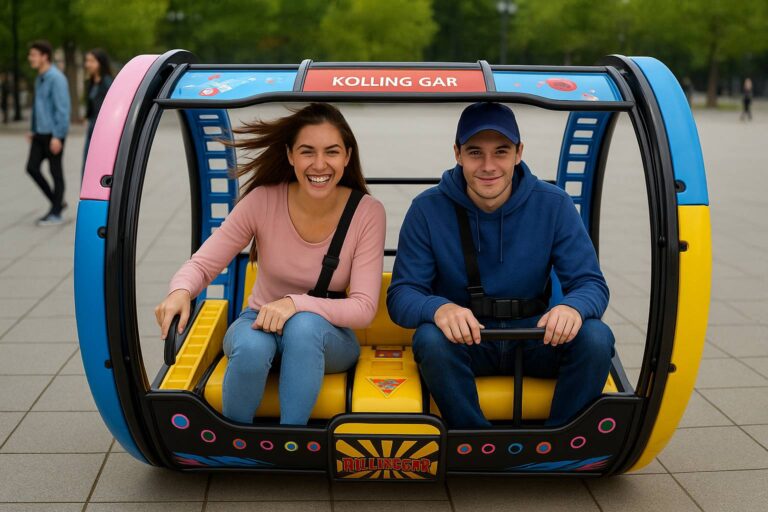
How fast is a 360 rolling car, and how do you read the specs?
As a long-time manufacturer of 360 rolling cars, we’ve seen many ways specs are written. In short, some makers list ground travel speed (how fast the vehicle moves along the floor), while others list rotation-related maximum speed (the speed at the rim while flipping/spinning). These are not the same thing, but they’re often mixed together—leading people to assume “this car runs extremely fast.”
How to read the speed spec
Ground travel speed: In everyday commercial scenarios, I usually set the vehicle to 40–60 m/min, i.e., about 2.4–3.6 km/h (1.5–2.2 mph). Think slow to brisk walking, suitable for stable operation in pedestrian environments.
Rotation-related speed: If you see something like “~2 m/s,” that describes performance during flipping/spinning—meant to convey the sense of excitement. It does not mean the car drives straight at 2 m/s.
How to avoid misreading speed numbers: First, determine whether the spec is about ground travel or rotation. Then convert the units to what you’re used to—m/min, km/h, mph—so you can quickly judge how fast it would feel in a real space.
Why does it feel “not fast yet still thrilling”?
The 360° flipping/spinning creates a stronger bodily sensation; so even without increasing ground speed, passengers feel it’s exciting. That’s why the industry standard is: “leave the excitement to rotation, keep the ground speed safe.”
What affects real-world experience?
Payload, battery level, and floor conditions all influence whether the same car seems fast or slow. During operations, speeds are typically tiered (low/medium/high) based on venue and foot traffic. So the speed sensation may vary across malls or plazas, but ground speed generally stays in the 2–4 km/h safety band.
Two quick tips for buyers and operators
When reading specs, first confirm whether the speed refers to ground travel or rotation.
Whatever the notation, convert the units clearly (m/min ↔ km/h ↔ mph), and set on-site speed limits according to foot traffic, so you get both experience and safety.
One-liner: Treat it as “slow-to-brisk walking ground speed + intense flipping sensation.” When you see a high number like 2 m/s, don’t panic—that usually describes rotation-related upper limits, not the car “racing” along the floor.
Why does a 360 rolling car need this speed range?
A 360 rolling car only needs 2–4 km/h ground speed for the following reasons:
The thrill comes mainly from “rotation,” not “running.”
The fun is in the cabin rotating around an axis. With rotation, points farther from the center trace longer arcs and feel faster—this is tangential speed: for the same rotational rate, a larger radius feels faster (think speed ≈ radius × rotational rate). So you don’t need high ground speed to get strong sensations.Keep “rotation speed” and “travel speed” separate.
Manufacturers sometimes write “max ~2 m/s,” usually referring to linear speed along the circular path during rotation; it describes how fast you’re carried around the circle, not forward ground speed. Separate the two to avoid assuming the car will “burst forward.”Why not crank up the ground speed?
In pedestrian venues, low ground speed is safer, and the “strong thrills” can be supplied by rotation. To maintain an inversion (like going “over the top”), you need sufficient speed at the top of the loop to “stick to the track” (popular science often explains this via the minimum top speed). In other words, you don’t need straight-line acceleration for thrills; suitable rotation and radius can achieve it.Analogy: minimum speed for looping.
Popular physics uses “loop-the-loop” examples to show there’s a minimum speed: too low and you “fall,” high enough and you pass smoothly. Several Wired explainers estimate minimum speeds on the order of a few meters per second for reasonable radii; the core idea is needing enough centripetal acceleration at the top or gravity wins. Our rolling car isn’t a giant loop-the-loop, but this helps explain why rotation alone can be sufficiently thrilling.Operationally, 2–4 km/h is “just right.”
Keeping ground speed in the slow-to-brisk walking range makes it easier to manage risk in malls, plazas, and family settings, while rotation provides the experience. This aligns with experience goals and operational reality. (In circular motion, the required inward force relates to speed—basic school physics on centripetal force/circular motion.)
Bottom line: Give the speed to rotation, keep the safety on the ground. That’s why a 360 rolling car usually needs only 2–4 km/h ground speed to feel thrilling and controllable.
360 Rolling Car Safety & Regulations
The safety philosophy is clear: thrills via rotation, risks controlled by ground behavior. From design to operations to on-site management, there’s a complete set of hard safeguards + soft management as backstops.
Common safety features (what you can see)
Restraints & posture: lap/shoulder belts; high backrests; wraparound seats to reduce sway and bumps.
Control & braking: emergency stop button; remote start/stop; tiered speed limits (low/medium/high); soft starts and gentle stops.
Visual cues: prominent labels for load/age/restricted riders; no long scarves, hard/sharp items; no lap-holding of children.
Operating essentials (how to use it more safely)
People–vehicle separation: fencing/cones to mark driving and queuing zones; fixed routes and docking points; no wrong-way driving or tailgating.
Pre-opening checks: inspect belts; brakes/steering; tires and bolts; body shell and light strips; horn; charging and battery status. If anything’s off, stop first, then inspect and log.
Dynamic speed limits: switch to low/medium when crowds are heavy, floors are slick, or during night sessions or poor weather; adjust upward only in open spaces; high for controlled demos only.
Staff & procedures: clear division between operators and roving marshals; reminders to buckle up and stow prohibited items; keep spacing; stop operations immediately for severe weather or abnormal vibration/noise.
Compliance framework (varies by region)
Design side: follow general design/structural safety standards like ASTM F2291 or EN 13814-1 (structural strength, redundancy, rider protection, etc.) to eliminate over-aggressive design risks at the source.
Operations side: base training, inspections, maintenance, and emergency drills on ASTM F770 or EN 13814-2/3; build a complete SOP with traceable records.
On-site side: enforce people–vehicle boundaries, fixed routes, docking management, and marshaling to ensure rules land in practice.
Understanding the “two layers of control”
Hard constraints (design/equipment): structure, braking, restraints, E-stop, and speed limiting—these are the built-in baselines.
Soft brakes (operations/site): training, inspections, record-keeping, tiered speed limits, and people–vehicle separation—these lock risk inside the process.
Red-line conditions (stop operations immediately)
Restraints or E-stop failure; shell/weld loosening or cracking; steering/brake lag.
Impact or water ingress; persistent abnormal noise/smell/temperature rise.
Inability to maintain people–vehicle separation; extensive floor slipperiness; severe windstorms/heavy rain, etc.
Don’t confuse with high-altitude rides
A 360 rolling car is a ground-level, low-speed flipping device. It’s not the same category as giant pendulums or roller coasters; risk levels and management methods differ.
Summary
Equipment side: E-stop/speed limiting/restraints are the first gate.
Operations side: training/inspections/records/drills are the second gate.
On-site side: people–vehicle boundaries and order are the third gate.
With all three gates working together, risk stays firmly contained within procedures and on-site control—delivering sustained, reliable 360° rotational fun.




 English
  Español
  العربية
  Français