
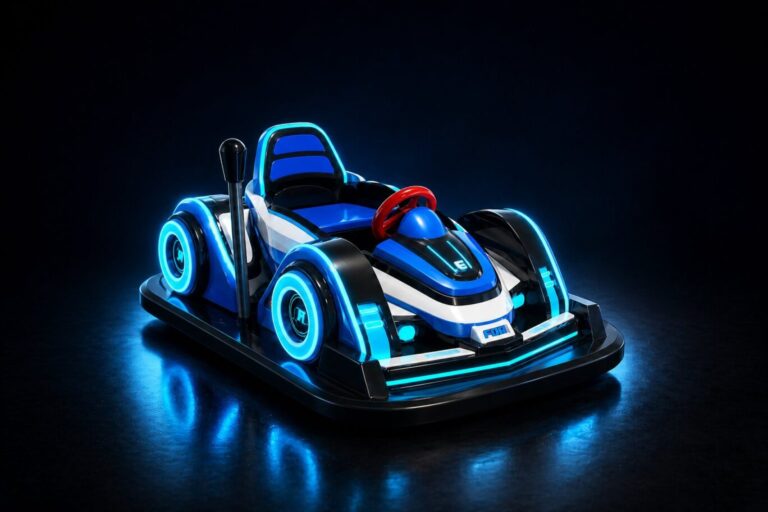
Offline entertainment is rebounding strongly, and malls and parks are doubling down on “experiential consumption.” Yet with increasing homogeneity, it’s hard to retain foot traffic or drive repeat visits. As a new family-friendly attraction that is both highly interactive and visibly safe, Le Bar Car (360 rolling car) has been rapidly adopted worldwide over the past two years: it has been showcased continuously at IAAPA and other leading industry expos, with audiences from 100+ countries and regions, and multiple parks and commercial venues have already installed and operated it. This article breaks down the seven core advantages of Le Bar Car to explain why it has become a global blockbuster.

Le Bar Car Advantage 1: 360° Free Rotation
(Not just “fun” — it’s a traffic engine)
Technical details
A multi-directional wheel set plus programmable motions allow the car to spin continuously 360° in place and change speed and direction at will. Unlike traditional “one loop along a fixed track” rides, it’s more crowd-gathering and more likely to be filmed and shared on site. The device is designed and operated under recognized amusement safety systems (e.g., ASTM F24 / EN 13814), easing parents’ concerns.
Technical details
Moves can be fast or slow and chained together, creating a controllable sense of weightlessness and thrills. The body and lighting respond interactively, making it striking from afar and naturally suited to short-video sharing. Research has already shown that short-video platforms significantly boost intent among younger visitors to go out and “check in.”
Operational value
Attract & dwell: Malls and “experience-centric formats” are using interactive attractions to pull traffic; industry reports show such “retail + entertainment” models increase footfall and dwell time.
Dwell = spending: Multiple studies link dwell time to higher spending; some quantify that increased dwell drives food & retail sales growth. Retail monthly tracking also treats longer average dwell as a signal of effective reach.
Built-in amplification: UGC is trusted more than traditional ads. Brands and retailers are intentionally growing their UGC share because it demonstrably improves conversion and decisions. On site, this becomes a loop of “crowd → filming → posting → more traffic.”
Le Bar Car Advantage 2: Dual-Axis Drive
(A stable, low-cost “invisible moat”)
Technical advantages
Dual motors/dual axes distribute power more evenly to each wheel set, reducing “one side pulling, the other side dragging,” for steadier operation and more balanced component stress. In industrial settings, multi-motor torque sharing is widely used to improve stability and reliability.
There’s also inherent redundancy: if one side experiences a minor fault, the other side can maintain basic motion, lowering the chance of a total halt — a “dual-redundant motor” concept proven in high-reliability fields.
User experience
Smoother starts, stops, and speed changes reduce jolts and sudden lateral forces, making riders less prone to motion sickness and queues more pleasant. Studies show lower lateral acceleration and more predictable paths significantly reduce motion sickness.
Operational upside (fewer worries, lower cost, less downtime)
A brushless DC motor (BLDC)-based drive is structurally simpler, wears less, and needs less frequent maintenance, making it ideal for long continuous runs that minimize maintenance cost and downtime.
In one line
Dual-axis = steadier power, fewer failures, smoother rides. For venues, that means fewer repairs, less downtime, fewer complaints — and more store visits and repeat business.
Le Bar Car Advantage 3: Safety-First, Family-Friendly Design
(Parents’ reason to say “yes”)
Foundational safety
Cabins prioritize “stable seating, secure restraint, visible safety”: choose 5-point harnesses, thickened guardrails, and soft cladding. Loads are spread across shoulders, hips, and waist to reduce sliding or impact during sudden stops or turns. The message “seatbelts make you safer” is repeatedly emphasized by authoritative bodies.
Detail optimizations
A low center of gravity plus extensive soft padding and rounded edges turn “hard hits” into “soft contact” wherever possible. Best practice in indoor/outdoor children’s play stresses materials that “absorb impact,” using g-max/HIC metrics to assess shock reduction — the better the padding, the lower the instantaneous head/body impact.
Compliance & braking
Design and operations benchmark international amusement safety systems (e.g., ASTM F24 series, EN 13814) across design, manufacturing, installation, inspection, and day-to-day use, ensuring the device is safe to use and audit-ready.
An operator-side emergency stop lets staff bring the ride to a safe stop instantly; the principles align with general machinery safety standards like ISO 13850.
What parents say
Parents value visibly obvious seatbelts, guardrails, soft padding, and an E-stop. When kids are smiling and adults can “see the safety,” trust and repeat intent rise.
Le Bar Car Advantage 4: Smart Interactivity
(Upgrading from “a device” to “an experience scene”)
Feature specifics
Audio/reactive lighting: Lights sync to music so guests can “hear and see” the rhythm, markedly enhancing immersion and participation (tight audio-visual coupling grabs attention and spurs interaction).
Automated ticketing & cashless payment: Self-serve purchase/verification plus e-payments reduce queues and box-office workloads; industry cases show gains in efficiency and sales with lower labor needs.
Mobile remote monitoring/O&M: Back-end dashboards show device status, push alerts, and enable remote actions. IoT-based monitoring and predictive maintenance cut unplanned downtime.
Experience value
Less waiting, smoother flow: Theme-park satisfaction is heavily impacted by queue length; self-service and digital tools shorten both wait and checkout times.
More interaction, higher return intent: Stronger immersion and interactivity increase emotional engagement and revisitation (including among younger guests). Turning the device into a responsive stage encourages repeat play.
Lean staffing, scalable ops: Self-ticketing and automation free staff from repetitive tasks. One person can patrol multiple units by phone, lowering peak staffing.
Le Bar Car Advantage 5: High Customizability
(A “brand value booster” tailored to your venue)
Customization dimensions
Visuals: Change body colors/graphics; add park IP, mall logos, or campaign key visuals so the attraction “belongs here” at a glance. Unified theming strengthens memory and emotional connection.
Functions: Add event-specific décor (bubbles/ocean, ball pits, character fascias, prop mounts) to turn the device into a stage that supports programming.
Music/SFX: Built-in custom libraries (children’s songs, brand themes, holiday BGM) keep audio and visuals in sync to capture attention and participation.
Operational value
Stronger place-and-brand binding: Theming upgrades a spot from “a device” to “a story,” easier to remember and to “check in” socially.
IP that ‘speaks’: Mascots/characters have high affinity and broad reach; placing them on the device and nearby amplifies family and youth engagement.
Higher conversion: Customization = personalized experience. Brands that do personalization well see markedly higher revenue and conversion — logic that also applies to offline immersive events and themed ops.
Le Bar Car Advantage 6: Long Endurance & Low Energy Use
(The “invisible savings” in operating cost)
Data-backed
A lithium battery system stores more energy per unit weight and charges faster — ideal for “operate by day, recharge at night.” Compared with lead-acid, lithium offers higher energy density and charging efficiency with lower maintenance.
With a comparable capacity setup, a full charge can cover [≈8 hours] of continuous operation; if daily use is [≈6 hours], [nightly] unified charging is sufficient (actuals depend on your battery capacity and on-site intensity). This “work-by-day, charge-by-night” mirrors shift-based AGV/industrial mobile power routines.
Why it saves power
The BLDC core drive typically runs more efficiently than brushed motors: brushed commonly ~75–80%, brushless can reach ~85–90%, yielding ~10–20%+ energy savings while being more durable and lower-maintenance.
Faster charging = more hours “earning” vs. “waiting on the charger,” a direct lithium-over-lead-acid benefit.
Annual electricity savings
Illustrative example. If the local electricity price is [¥X/kWh] and the average daily energy use is [Y kWh], a [15%] efficiency gain yields an annual saving of roughly:
Annual saving ≈ X × Y × 365 × 15%.
For instance, at ¥0.80/kWh and 20 kWh/day, the saving is about ¥876 per year.
Actual results vary with runtime intensity, battery capacity, and charging strategy.
Operational scenarios (more flexible, less downtime)
No fixed power needed: Battery operation means flexible placement without outlet constraints, avoiding “loose cables/trip hazards,” ideal for atrium pop-ups, outdoor plazas, and temporary exhibits. Retail has broadly adopted battery-powered mobile gear (e.g., portable digital signage, mobile workstations) precisely for “place as you like, minimal retrofit.”
Fewer surprise halts: With remote monitoring and SoC/health alerts, you can schedule charging and maintenance proactively to avoid sudden stoppages.
In one line
Reduce “energy and charging time,” increase “placement flexibility and usable hours” — save power, labor, and hassle for real bottom-line gains.
Le Bar Car Advantage 7: Ultra-Simple Operation
(Operator-friendly, lowering the staffing bar)
Operational design
One-touch start/stop + large buttons/clear icons: Consolidate routine actions into “Start/Stop,” color-coded and fixed positions to minimize mistakes. This Start/Stop paradigm is time-tested in industrial equipment for lowering learning curves.
Visual prompts + step-by-step guidance: Indicators, screens/labels cue the next action. Visual management and 5S use prominent colors/markings to clarify process, boosting efficiency and reducing errors.
Error-proofing details: Design steps so common mistakes “can’t happen or are obvious at a glance” (e.g., enforced sequence confirmations, interlocks that prevent unsafe starts). Poka-yoke is repeatedly proven in manufacturing and services to cut human error.
User value (front-line and scheduling benefits)
Faster training: The simpler the UI/flow, the lower the training cost; research and practice show usable interfaces and clear SOPs shorten training and improve consistency.
Lower hiring threshold: Follow the steps and anyone can start/stop safely and perform routine checks — no technical background required. Clear SOPs and visual aids sustain quality through shift changes and turnover.
Fewer operational mistakes = less downtime: Standardization and visual cues reduce “forgot that step/pressed the wrong key,” lowering sudden stoppages and on-site correction costs.
In one line
Keep complexity inside the device and simplicity for the operator: big buttons, fewer steps, readable cues, standard flow — new staff can get hands-on in minutes, scheduling stays flexible, and the floor runs steadier with less effort.
Competitive Comparison: What Makes Le Bar Car Hard to Replace?
Here, we benchmark three attraction types—VR/media-based devices (content-led, low external visibility), traditional mall kiddie rides (teacups/bumper cars with fixed play patterns), and Le Bar Car (360° free rotation with interactive sync and mobile deployment)—and compare them across four dimensions: safety & compliance, interactivity & virality, customization flexibility, and deployment & operations.
Safety & compliance
VR/media: Motion is controllable, content-centric, but “visible safety” elements on site are limited.
Traditional kiddie rides: Many categories; standards depend on vendor consistency.
Le Bar Car: End-to-end checklists from design to operations. Restraints, padding, and E-stop are obvious at a glance — ideal for long-term operations and transparent disclosures.
Interactivity & virality
VR/media: Users are inside headsets; low spectator appeal; secondary traffic relies on in-store conversion.
Traditional kiddie rides: Eye-catching looks but few interactive beats; limited replay drive.
Le Bar Car: Real people + 360° spins + light-music sync make it inherently “camera-ready,” fostering UGC and secondary inflows.
Customization flexibility
VR/media: Theming mainly via content playlist or wraps; limited space re-theming.
Traditional kiddie rides: Fixed models; can recolor/re-sticker, but structure and play pattern are hard to change.
Le Bar Car: Exterior, lighting, music, and props all themeable by season/brand — one unit can “change skins and tempo.”
Deployment & operations
VR/media: Requires fixed position and stable power; training covers both content and hardware.
Traditional kiddie rides: Often depend on on-site cabling and attendants.
Le Bar Car: Battery “work-by-day, charge-by-night,” one-touch start/stop + remote patrol — fast to land, minimal retrofit, low staffing.
Bottom line
It’s not simply “better”; it’s better suited to investors chasing long-term operating returns: Le Bar Car bundles “visible interaction, repeatable operations, and themeable upgrades,” covering atriums, park pathways, and city pop-ups with the same unit — driving both traffic and efficiency.
FAQ
What is the ASTM and F24 standard?
ASTM F24 is a series of safety standards for amusement rides and devices. Le Bar Car is designed and operated benchmarking this framework across design, manufacturing, installation, inspection, and daily operation, with visible safety measures such as a 5-point harness, reinforced guardrails, soft padding, and an operator emergency stop (E-stop).
What are the safety regulations for amusement park rides?
Operations benchmark internationally recognized systems—primarily ASTM F24 and EN 13814—covering end-to-end controls from design and manufacturing through installation, inspection, and daily use.
What is the EN 13814 standard?
EN 13814 is a key European safety standard for amusement rides. Le Bar Car’s design and operations are benchmarked to the controls and lifecycle requirements it outlines, alongside ASTM F24.
Which safety factors must be considered for the amusement park?
For Le Bar Car deployment: stable seating and a 5-point restraint, reinforced guardrails and soft cladding (impact-absorbing mindset, g-max/HIC), low center of gravity and rounded edges, a clearly accessible E-stop, and documented SOPs spanning installation, inspection, and daily operations.
What is the ASTM F24 Committee on Amusement Rides and Device?
It is the ASTM committee responsible for the F24 series covering amusement rides and devices—a core framework used for Le Bar Car’s safety and operational benchmarking.
What are the specialities of Le Bar Car 360?
Seven core advantages: 360° free rotation (crowd-pulling, highly shareable); dual-axis/dual-motor drive (stability, redundancy, fewer failures); safety-first, family-friendly design (5-point harness, padding, E-stop); smart interactivity (music-synced lighting, self-service ticketing, cashless); high customizability (visuals, IP/branding, props, music/SFX); long endurance & low energy use (lithium system + BLDC efficiency); and ultra-simple operation (one-touch start/stop, visual prompts, error-proofing).
Conclusion
Le Bar Car succeeds by packaging “fun” + “operability.” Safety is visible, interactivity is strong, deployment is quick, and costs are stable — a source of joy for visitors and a tool for returns for operators.

 English
  Español
  العربية
  Français