
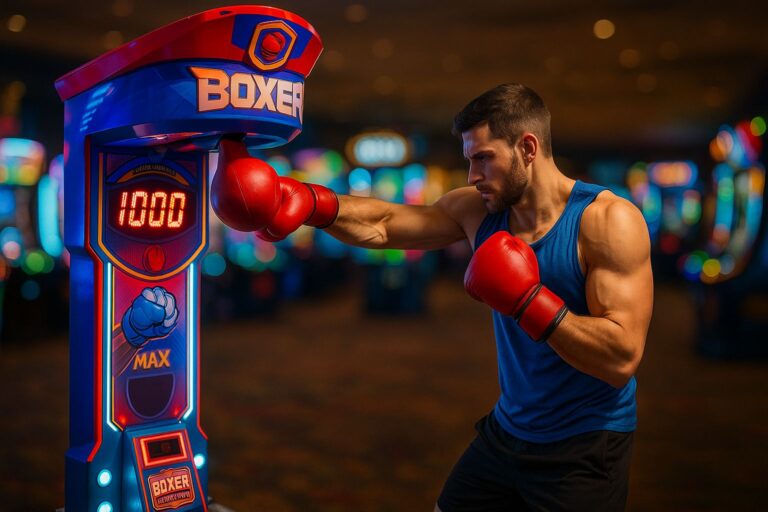
As an experienced punching-machine manufacturer, LeYou has long served arcades and training gyms. One of the most common questions we hear from customers and players is: “punching power of 1000 is equal to what, exactly?” To make this intuitive, we’ll interpret “1000” as a 1000-pound (lbf) punch, and use plain, real-world comparisons so you can build quick intuition in 30 seconds and gain a full understanding in a few minutes.
What does “Punching Power of 1000” really mean?
Before we break down what punching power of 1000 is equal to, let’s align on three physics ideas:
What is Force? (Newtons)
Force is the magnitude of a push or pull. The SI unit is the Newton (N).
In boxing, you’ll often see 1000 lbf (pounds-force); in SI that’s about 4,448 N (because 1 lbf ≈ 4.448 N). This is just a unit conversion so we’re all using the same measuring stick.
Keep in mind: punch readings are usually peak, momentary values—the maximum impact delivered in a very short time.
What is Energy? (Joules)
Energy (work) is essentially force × distance—how far the force pushes, compresses, or deforms something.
A quick “1000-pound punch” example: if the target compresses or is pushed back 0.6 m, then the energy is roughly:
4448 N × 0.6 m ≈ 2669 J.
What’s 2669 J? About the gravitational potential energy needed to lift a 10 kg object by ~27 m (10 × 9.81 × 27 ≈ 2649 J).
Why Pressure (PSI) often determines damage
Pressure = Force ÷ Contact Area. Same force on a smaller area → higher pressure; spread over a larger area → lower pressure. That’s why knuckles hit “harder” than an open palm.
In imperial units we use PSI (pounds per square inch). 1 PSI = 6,894.76 Pa. Using PSI makes the trade-off between force and area easy to see.
In the real world, protective gear, heavy bags, and car body panels reduce local pressure and the instantaneous spike by distributing the same force over larger area and longer time.
In one sentence: Force (N) tells you how hard the punch is, Energy (J) tells you how much “work” it does, and Pressure (PSI) often decides how injurious it is.
Six ways to grasp what “punching power of 1000” equals
Using the Force/Energy/Pressure framework, here are six intuitive lenses:
1) Human vs. human (the most intuitive)
A quick punch-force ladder for context:
| Level | Punch Force (lbf) |
|---|---|
| Average adult | 300–600 |
| Fitness enthusiast | 600–900 |
| Pro fighter | 1000–1400+ |
| Champion tier | 1300–1800 |
So, “1000 lbf” sits at the entry line for professional fighters—well above most amateurs and average adults.
2) Sports impacts (feel it in the gym)
Pro baseball sweet-spot hit: A bat striking at ~100 mph—the instantaneous, “hard” feel can resemble a 1000-pound punch landing flush.
Muay Thai/Karate shin round kick: Into a thick bag or pad, one brutal sweep can feel like a thousand-pound-class impact.
Football collision: A full-speed tackle that “pins” you on contact often feels close to a 1000-lbf momentary hit.
3) Tools and objects (never underestimate a tool)
8–10 lb sledgehammer, full swing: A skilled strike into a steel stake or thick timber gives an intuitive sense of a “1000-pound punch.”
Jackhammer/impact drill: Single pulses may be lower, but the sharp, instantaneous spike is often described as “like being tagged by a 1000-lbf hit.”
Setting down a 20–30 kg weight hard: That solid “thud” into the floor mimics the feel of a thousand-pound punch into a rigid target.
4) Everyday life (everyone’s felt these)
Heavy door slamming a frame: That sudden pile-on of mass has the same snap-to-max feeling as a 1000-lbf punch.
Dropping a heavy object onto a hard table: The rebound shock through your forearm has a similar return jolt.
Driving a heavy bag back hard: If you can make a thick bag “buckle,” then imagine one notch higher—that’s the 1000-lbf class.
A firecracker up close: The crisp pressure wave near your ear mirrors the “instant pressure” feel of a big punch landing clean.
5) Animal power (order-of-magnitude feel, not a strict match)
Kangaroo back-kick / bighorn ram’s headbutt: Often described in the hundreds to ~thousand-pound impact range. Think: a serious animal strike ≈ a 1000-lbf punch in felt shock.
A large dog slamming into you at speed: Not a punch, but the sudden chest-thumping shove feels comparable.
6) Vehicles & moving objects (felt impact, not equivalent outcomes)
A slow “tap” from a small car: The instant “pinned” feeling is reminiscent of a 1000-lbf hit.
Sudden gust/mini whirlwind: A sharp push that makes you lose footing can feel 1000-class in momentary force.
Note: Cars have far greater mass than people, and the injury mechanisms differ. The feel can be similar; the outcomes are not.
How dangerous is a 1000-pound punch?
Potential severe injuries
Rib fractures: can occur from ~900 lbf
Concussion: immediate, with risk of lasting damage
Internal organ injury: liver/spleen bleeding possible
Mandibular fractures: may require complex surgery
Loss of consciousness: sometimes with respiratory pause
Key factors that influence severity
Target area: Body shots (abdomen) are generally safer than head shots
Body state: Bracing and muscle tension can reduce harm
Protective gear: Gloves significantly lower peak pressure
Strike angle: Perpendicular blows tend to be riskier than glancing shots

How to build toward a 1000-lbf punch—safely and scientifically
What it typically takes
Natural base: innate explosiveness and muscle mass
Professional training: ~3–5 years of systematic boxing practice
Technical mastery: a crisp, efficient kinetic chain
Physical qualities: core strength, speed, coordination
Programming suggestions
Core rotational power: Russian twists, medicine-ball throws
Explosiveness: squat jumps, box jumps
Upper-body strength: bench press, pull-ups
Technical priorities
Polish the kinetic chain: feet → hips → trunk → shoulder → fist
Prioritize speed: hand speed often matters more than raw strength
Accuracy work: hitting the right spot matters more than absolute force
Safety first
Progress gradually
Warm up and cool down fully
Train under a qualified coach
Schedule recovery regularly
Record breakers: monsters beyond 1000 lbf
Francis Ngannou
Recorded punch force: ~1294 lbf
Rough equivalent: a small car at ~45 km/h
Notes: UFC heavyweight champion with legendary powerMike Tyson
Peak punch force: ~1600 lbf
Rough equivalent: a full-charge hit from a bighorn ram
Notes: exemplary blend of speed and powerDeontay Wilder
Measured punch force: ~1400 lbf
Rough equivalent: a sledgehammer swung with full intent
Notes: elite heavyweight knockout artist
FAQ
Is 1000 on a punching machine good?
Yes. In our force ladder, ~1000 lbf sits at the entry line for professional fighters, well above most amateurs and average adults.
What is a good score on a punching machine?
For casual players, 600–900 is a solid “good” range. ~1000 and above is typically pro-level on machines that reflect peak impact.
What is the average score on a punching machine?
Most average adults land around 300–600 on typical arcade punching machines.
How many lbs of force are in a punch?
It varies by person and technique: ~300–600 lbf for average adults, ~600–900 lbf for trained gym-goers, and ~1000–1400+ lbf for pros.
How many joules are in a boxer’s punch?
Energy depends on how far the target moves (work = force × distance). Using our example, a 1000 lbf (~4448 N) punch that compresses the target 0.6 m is roughly ~2669 J.
How many psi can a human punch?
PSI depends on contact area and gloves. The same force on bare knuckles produces far higher PSI than on a padded glove because pressure = force ÷ area. There isn’t a single universal PSI number.
Do punching machines measure force?
Most arcade units output a peak-impact score (a proxy for force/impulse). Some models can display lbf or N, but many use an internal 0–999/1000+ scale rather than calibrated force.
Are all punching machines calibrated the same?
No. Spring tension, sensor type, target travel, and firmware differ by brand/model, so identical punches can score differently on different machines.
What are punching machines measured in?
Depends on the model: some show lbf (pounds-force) or N (newtons); many arcade machines show an arbitrary score (e.g., 0–999) that represents peak impact.
How good is 900 on punching machines?
900 is strong for a recreational player and near the top of fitness-enthusiast ranges. Pros often break ~1000 on comparable machines.
What is the most powerful punch ever recorded?
Publicly cited standouts include Mike Tyson (~1600 lbf) and Deontay Wilder (~1400 lbf) in demonstrations, and Francis Ngannou (~1294 lbf) on a machine test—illustrating elite, beyond-1000-lbf power.
Is it good to get 600 on a punching machine?
Yes—600 is a respectable score for a beginner/average adult and sits at the upper end of the 300–600 “average adult” band.
Is 700 on a punching machine good?
Yes. 700 is solid above-average performance and typical of recreational athletes with some training.
Is 850 good on a punching machine?
Yes—850 is very strong for non-pros and indicates good technique and power, approaching the ~900+ tier.
What is the force of a human punch in newtons?
Convert lbf → N with 1 lbf ≈ 4.448 N. That puts average adults (~300–600 lbf) at roughly 1330–2669 N, and a 1000 lbf punch at about 4448 N.
Who has the strongest punch ever recorded?
In public demos and machine tests, Mike Tyson is often cited with a peak around ~1,600 lbf—well above the Punching Power of 1000 benchmark. Other elite readings include Deontay Wilder ~1,400 lbf and Francis Ngannou ~1,294 lbf on a machine test. Because devices and setups vary (calibration, target travel, scoring), there’s no single official world record—results are device-dependent peak values rather than a unified standard.




 English
  Español
  العربية
  Français