
The most common recommended age for a “360 rolling car / spin car / wiggle car” is 3 years and up (many brands label 3+). Some commercial 360 rolling entertainment cars recommend 6+ with adult supervision. Most models have generous weight limits—typically up to 100 kg (≈220 lb)—so elementary-age kids, teens, and even adults under the limit can ride. However, load ratings (≈50–100 kg), body size, and venue requirements vary widely by product. Always follow the manufacturer’s label, and use on flat, smooth surfaces with an adult present to balance safety and fun.
Quick Index: Recommended Ages for 360 Rolling Car Types
Use this table to quickly match a 360 rolling car by age/height and play intensity (always defer to the maker’s label; supervise as needed).
| Type | Recommended Age | Key Points |
|---|---|---|
| Preschool models (indoor/slow, e.g., spinning bumper cars) | 1.5–6 years | Low speed, cushioned bumpers, indoor-friendly; optional parent remote; typical load ≈30 kg; constant supervision. |
| Standard control models (entry/mid-speed: swing/drift) | 4–12 years | Most comfortable at ≥100 cm height; common load 45–70 kg; flat ground only; supervision advised. |
| Standard electric control (advanced drift) | 9–13 years+ | Can rotate/drift in place; typical load ≈63–64 kg; helmet + pads recommended; parent nearby is safer. |
| Large/reinforced models (teens/adults) | 16+ | Bigger frames and more power; need wide, closed courses; loads up to ≈109 kg / 240 lb; strict supervision and local-rule compliance. |
| Combo/conversion kits (hoverboard-to-kart, etc.) | 8+ | Convert a hoverboard into a seated kart; common load ≈90 kg / 198 lb (check kit/base); prefer electric bases with recognized safety certifications; supervision advised. |
Tip: Choose by age/height fit → weight limit match → safe venue & supervision to avoid mismatches.
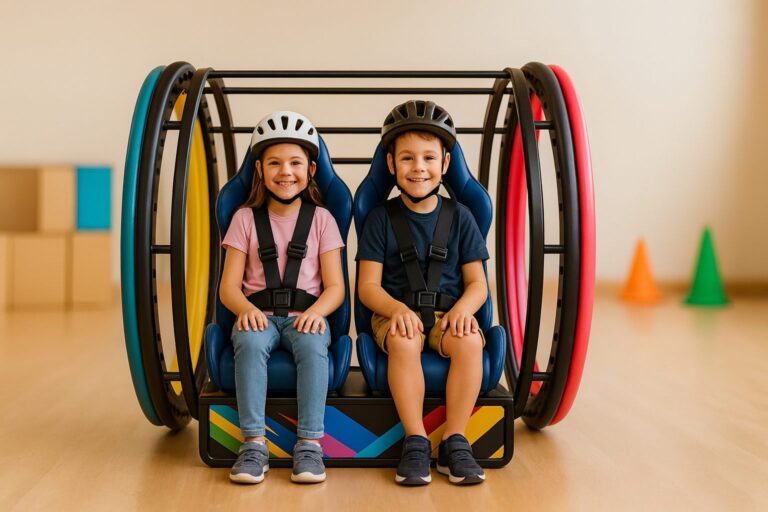
360 Rolling Car by Age Stage (Details)
Early Childhood (3–5 Years Old)
Safety first. Prioritize low-speed, four-wheel, more stable indoor models with parent remote and cushioned bumpers; keep an adult present at all times and use a helmet (same class as scooters/trikes). Pediatric and safety bodies broadly advise: wheeled toys → helmets, and flat, open areas are safer.
Developmental benefits. Builds hand-eye coordination and spatial awareness; helps kids grasp “accelerate—decelerate—stop.” Use “slow—stop—go again” mini-games to instill risk awareness.
Best-fit models. Indoor slow-spinning/bumper styles (typical load ≈30 kg; many labels show 18–72 months or 1.5–6 years).
Children (6–12 Years Old) — Key Points
Independent operation begins. With supervision, most kids can handle entry models (foot-propelled swing/drift or low-power electric). Brands often state 6+ or 8+; still control venue and speed.
Social & play value. Set simple rules with friends (slow speed, one-way, take turns) to release energy and build cooperation—standards stress that parent supervision can’t be replaced by labels.
Safety upgrade. As kids try faster turns/drifts: helmet is a must, add knee/elbow pads; dry, flat surfaces only, away from roads and slopes.
Reference range. Many entry/mid-speed models list 4–14 or 6–12 years with 45–70 kg loads; follow each maker’s label.
Teens & Adults (13+)
Beyond “play”: skill progression. Advanced electric models for 13+ or 16+ go faster and can rotate/drift in place—better as an upgrade after basics. Makers commonly suggest 9+ for standard models and 16+ for large ones, emphasizing fit, skill, and maturity.
Gear & venue matter more. Full pads and athletic shoes; practice only on wide, enclosed, hard surfaces. If there’s a parent/low-speed switch, start low.
Family time. Adults within the weight limit (large models up to ≈240 lb/109 kg) can join, co-plan routes, and set “safe zones,” turning rules into family habits.
Summary rule of three (all ages): Check age/ability match → weight/fit → venue & protective gear. Labels set the floor; real-time parental judgment is crucial.
Beyond Age: Other Crucial Factors for 360 Rolling Cars
Height & Weight Limits
Start with load and height. Entry/swing types often allow up to 70 kg (154 lb); advanced/large electric models can reach 109 kg (240 lb). Exceeding limits affects braking and structural safety. Use the product page label.
“Can they reach?” Many entry models are more comfortable from around 100 cm height—legs should rest naturally for pedaling or foot-bracing, and hands should grip controls securely.
Read labels & manuals. Toy-type ride-ons for under-14s fall under ASTM F963; electric self-balancing bases (some conversion kits) should note UL 2272 for battery/electrical safety.
Maturity & Coordination
Age is a guide; readiness matters. CPSC age guidance stresses: labels are references; parents should decide based on strength, attention, and rule awareness.
Begin low-speed, low-complexity. Practice “start—slow roll—brake—turn” on flat, open ground before rotation/drift; four-wheel, wider-base models feel more stable for transitions.
Supervision & gear—non-negotiable. Helmet at minimum; add pads as intensity rises. Pediatric guidance also favors active supervision and reading warning labels.
Home Models vs. Amusement/Commercial Rides
Home (toy category). Governed mainly by ASTM F963 and CPSC toy frameworks—labels show age/weight/warnings and call for adult supervision.
Amusement/commercial equipment. Typically follows ASTM F24 series (e.g., F2291 design guidance) covering design, operations, maintenance, and inspections—managed by local rules and venues.
In one line: At home, check toy/electrical safety + supervision; in venues, ensure amusement-ride standards and professional operation—don’t mix the two frameworks.
Shopping workflow: Measure height, check weight limit, verify labels & certifications, then match use venue (home/community space/venue). This beats picking by age alone.
Benefits of 360 Rolling Cars for Kids
More movement & fitness. Riding, turning, and modulating speed increase daily activity time; paired with running/jumping can help meet ~60 minutes/day moderate-to-vigorous activity for heart, muscles, and bones.
Balance & coordination. Rotation and directional changes train balance, spatial sense, and hand-eye coordination—gross-motor skills that unlock broader sports.
Right-sized vestibular input. Short, sensible spinning can support balance and posture control for some kids; since spinning is a strong stimulus, keep it brief and watch reactions—pale face or nausea → rest immediately.
Focus & confidence. Completing small tasks (start, stop, turn) under clear rules builds visible achievement; outdoor play correlates with better attention and mood.
Social skills. Simple courses plus taking turns/one-way rules foster observation, waiting, and communication.
Outdoor habits. These toys naturally draw kids outside and pair well with ball games and cycling, building long-term activity routines.
Parent tip (turn benefits into “bonus points”): Start slow and short, observe reactions; helmet at minimum, flat/open ground only; treat the 360 car as an on-ramp to outdoor activity, alternating with running and ball games for both fun and health.
Safety Checklist for Families
Know the labels & certifications. Confirm age/weight fit first. For toy-type home models, look for ASTM F963; for battery/converted electric bases, prefer clear UL 2272 or equivalent battery/charging safety information.
30-second pre-ride check. Screws, pedals/steering, wheels/rollers—look for looseness/noise; don’t ride if damaged—repair first.
Gear up. Helmet required (CPSC bicycle-class is fine); add knee/elbow pads for higher-intensity play.
Dress right. Closed-toe athletic shoes with tied laces; avoid sandals and trailing clothing.
Choose proper venues. Flat, dry, open hard surfaces; stay away from roads, slopes, water, and crowds.
Set rules + supervise. Start slow, one-way traffic, take turns; adult present throughout—standards are the floor, not a substitute for supervision.
Charging & storage (electric). Use original/recommended chargers; charge with someone nearby, not overnight; keep away from combustibles and exits. Unplug when full; if the battery is struck or unusually hot, stop use and contact support.
Stop if unwell. Pale, nauseous, or dizzy? Rest immediately, switch to short, low-speed sessions; consult a doctor if needed.
Maintain regularly. Follow the manual’s schedule; if you see cracks, looseness, or battery issues, stop until fixed.
Pro tip: Print this checklist and keep it by the garage door or in the box—checking these 8 items before each ride greatly reduces injury and battery risks.
FAQ
What age is a 360 rolling car for?
Typically 3+ years, with some commercial spinning models recommending 6+ with adult supervision. Always check the maker’s age label and match it to the child’s height/ability, not age alone.
Can a 2 year old use a wiggle car?
Only if the product is labeled for that age (e.g., 18–36 months) and with close adult supervision. Pick slow, stable, indoor models and keep sessions short.
Are 360 rolling cars safe?
They can be when used as labeled, on flat smooth surfaces, with a helmet and active adult supervision. Start slow, add knee/elbow pads as intensity rises.
Are 360 rolling cars suitable for indoors?
Slow, cushioned “spinning bumper” styles are indoor-friendly. Use flat, dry floors; keep an adult present; avoid crowded or cluttered spaces.
What is the weight limit for a toy car?
It varies widely—roughly ~30 kg for preschool spin models to ~45–70 kg for entry/mid-speed, and up to ~109 kg for large models. Always follow the product’s load rating.
How to connect remote to kids ride-on car?
Follow the manual: power the car and remote, press/hold the pair/sync button(s), and confirm connection before riding. Pair in a clear area with the car stationary.
What are the safety requirements of ASTM F963?
ASTM F963 is the U.S. toy safety standard used for under-14s; toy-type ride-ons should indicate conformance on labels/warnings. Always read and follow those labels.
What is UL 2272 certified mean?
UL 2272 relates to electrical/battery safety for self-balancing electric bases. If using a hoverboard-to-kart conversion, prefer bases with clear UL 2272 info.
How to relieve nausea from spinning?
Stop immediately, rest, and shorten future sessions. Keep play low-speed and brief; resume only when the child feels well and hydrated.
Conclusion
Fit > age. Choosing a 360 rolling car isn’t only about “how old”; verify height/weight, operating maturity, and use scenario. Meet label conditions and progress difficulty gradually for safer, better experiences.
Safety is the baseline. At every stage: helmet first, add pads as needed; flat, open, dry ground only; continuous adult supervision with the basic “slow—one-way—take turns” rules.
Start slow, step up. Learn start—brake—turn before rotation and drifting; if a child feels dizzy or nauseous, stop immediately and switch to shorter, slower sessions.
Respect manuals & certifications. Follow maker instructions when buying and using; for home toy-type models, check age/weight/warnings; for battery products, prefer clear safety certifications and original chargers.
Inspect & maintain. Do a 30-second pre-ride check (fasteners, wheels, pedals, steering); repair before riding if anything seems off.
Use it as an “outdoor gateway.” Alternate with cycling, running, and ball games to build fitness, balance, and cooperation—turning fun into long-term active habits.
One line: Pick the right car, wear the right gear, supervise, and progress gradually—that’s how a 360 rolling car stays safe, fun, and sustainable. If you’d like, I can condense the “Age vs. Model Table + Family Safety Checklist” into a printable one-pager for easy sharing.




 English
  Español
  العربية
  Français